
How to Fix High Indoor Humidity Even With Your AC Running
Fix high humidity inside house even with ac running by learning why your AC may not be removing moisture properly and what Houston homeowners can do to restore comfort.
Why Your House Feels Humid Even With the AC Running
If you're dealing with high humidity inside your house even with AC running, you're not alone — and the fix isn't always as simple as turning down the thermostat. Here's a quick look at why it happens:
Common reasons your AC isn't removing humidity:
- Oversized AC unit — cools the air too fast and shuts off before removing enough moisture
- Fan set to "ON" — runs continuously, blowing moisture back into your home
- Dirty air filter or coils — blocks airflow and reduces the system's ability to dehumidify
- Low refrigerant — weakens the evaporator coil's moisture-removal capacity
- Leaky ductwork — pulls humid Gulf Coast air into your system from the attic or crawl space
- Short cycling — AC runs in brief bursts (5–8 minutes) instead of the 15–20 minutes needed to pull moisture out
Here in the greater Houston area, summer outdoor humidity regularly tops 80%, which puts enormous pressure on any AC system. When your system isn't dehumidifying properly, indoor humidity can climb above 60% — making a 72°F home feel closer to 76°F or warmer. That sticky, heavy feeling isn't just uncomfortable. It raises your mold risk, strains your HVAC equipment, and drives up your energy bills.
The good news: most causes are diagnosable and fixable. This guide walks you through exactly what's going wrong and what you can do about it.
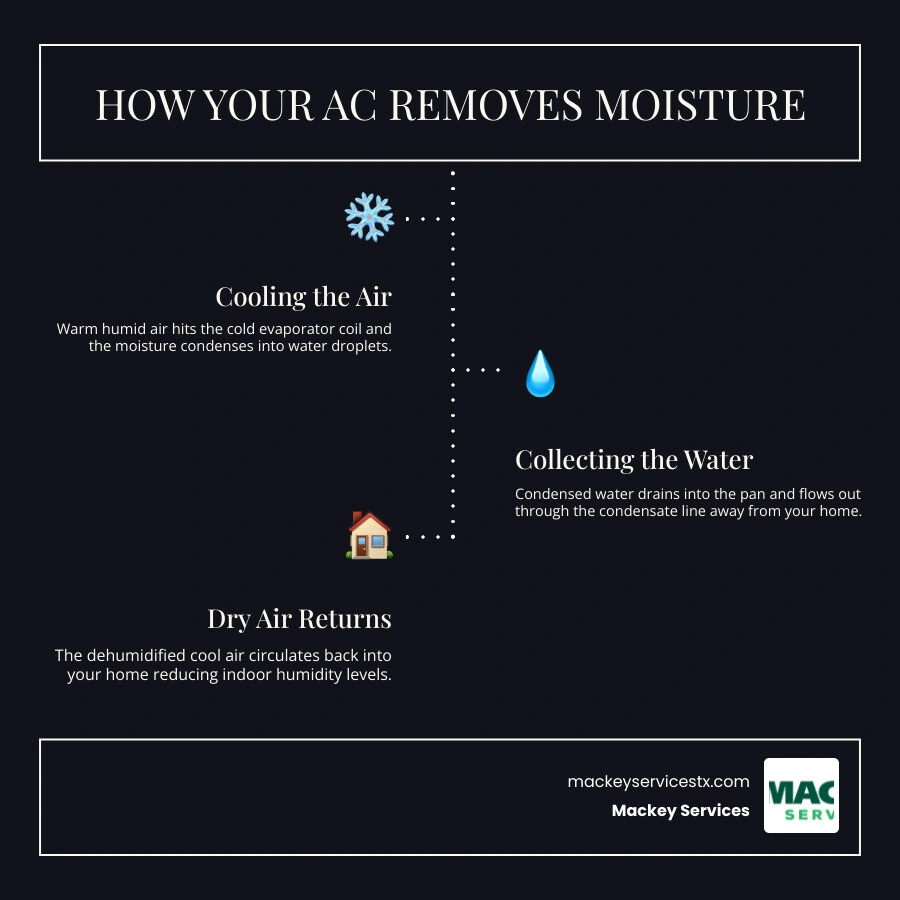
Why is there high humidity inside house even with ac running?

When we talk about comfort in places like Dickinson or League City, we aren't just talking about the number on the thermostat. We’re talking about "relative humidity." Think of the air like a sponge. Warm air is a big, bouncy sponge that can hold a lot of water. Cold air is a tiny, tight sponge. As your AC cools the air, it effectively shrinks that sponge, forcing the water out.
However, many homeowners find themselves in a "cool but clammy" situation. You might see 70°F on the wall, but you feel like you’re living in a swamp. This happens because your air conditioner has two distinct jobs: it has to remove "sensible heat" (the temperature you see) and "latent heat" (the moisture you feel).
The Short Cycling Struggle
One of the most common reasons for high humidity inside house even with ac running is short cycling. To effectively remove moisture, an AC unit needs to run for at least 15 to 20 minutes at a time. This gives the evaporator coil enough time to get cold and stay cold, allowing water vapor to condense into liquid.
If your unit is oversized for your home—a common mistake in some older Houston builds—it will blast the house with cold air so quickly that the thermostat reaches its goal in 5 or 8 minutes. The air is cool, but the "sponge" hasn't had time to be wrung out. This leaves the indoor humidity 10–20% higher than recommended levels. You can learn more about how our local environment plays a role in How Texas Pollen and Humidity Affect Indoor Air.
The Heat Index at Home
You know how the local news says it’s 95°F but "feels like" 105°F? The same thing happens inside. Indoor humidity above 60% can make your home feel 4–6°F warmer than the actual temperature. This is because your body’s primary cooling mechanism—sweat—cannot evaporate into air that is already saturated with water. When the humidity is high, you stay sticky, and your AC has to work twice as hard to make you feel even remotely comfortable.
Common HVAC Culprits for Persistent Dampness
If your system used to keep you dry but now leaves you damp, there might be a mechanical failure at play. We’ve been serving the Greater Houston area for 30 years, and we’ve seen these usual suspects time and time again.
Dirty Air Filters and Airflow Restrictions
An air conditioner is essentially a giant breathing machine. If the "lungs" (your air filters) are clogged with dust, pet hair, or Texas pollen, the airflow slows down. When air doesn't move across the evaporator coils at the right speed, the moisture removal process stalls. In some cases, the coil gets so cold it actually freezes over, turning into a block of ice that can’t absorb any more moisture or heat.
Low Refrigerant Levels
Refrigerant is the lifeblood of your cooling system. If there is a leak, the evaporator coil won't reach the proper temperature to condense water vapor. Low refrigerant levels can reduce an AC’s dehumidification capacity by 15–25%. You’ll notice the air coming out of the vents is "coolish" but the house remains persistently humid. This is a common issue we address for residents seeking Whole House Dehumidification League City TX.
Condensate Drain Blockages
As your AC pulls water out of the air, that water has to go somewhere. It drips into a drain pan and flows out through a condensate line. In our humid climate, algae and sludge love to grow in these lines. If the line is blocked, that water can sit in the pan, or worse, overflow. Even if it doesn't overflow, having a pool of standing water inside your HVAC closet is like having a tiny, unwanted sauna inside your house. For those in Pearland, ensuring these lines are clear is a vital part of Whole House Dehumidification Pearland TX.
Thermostat Settings and High Humidity Inside House Even With AC Running
Sometimes the problem isn't the machine; it's the settings. Most thermostats have a "Fan" setting with two options: AUTO and ON.
- Fan ON: The blower fan runs 24/7, even when the AC isn't actively cooling. This sounds like a good idea for circulation, but it's a humidity nightmare. After a cooling cycle ends, the evaporator coil is soaking wet. If the fan stays on, it blows air over that wet coil and pushes all that moisture right back into your living room.
- Fan AUTO: This is the gold standard for humidity control. The fan only runs when the system is actively cooling and dehumidifying. Once the cycle ends, the fan stops, allowing the water on the coil to drip down into the drain pan and out of your house.
If you’re in Friendswood and can’t seem to get the settings right, we often recommend smart thermostats that have built-in dehumidification logic. Check out our services for Whole House Dehumidification Friendswood TX to see how modern controls can help.
Duct Leaks and High Humidity Inside House Even With AC Running
Your ductwork is the highway for your home's air. If that highway has "potholes" or leaks, you’re in trouble. In the Houston area, most ducts run through the attic—which can reach 140°F in July. If your return ducts have leaks, they pull in hot, humid, unconditioned attic air and mix it with your clean, cool air.
Homes with duct leaks can experience up to 30% higher indoor humidity. This creates a "negative pressure" situation where your house starts sucking in humid air from every crack around your windows and doors. We specialize in sealing these leaks for our neighbors, providing effective Whole House Dehumidification Dickinson TX and Whole House Dehumidification Santa Fe TX.
Long-Term Solutions for Houston Homeowners
Sometimes, even a perfectly functioning AC can't keep up with the brutal humidity of the Gulf Coast. In these cases, we look at long-term upgrades that transform your home from a damp cave into a crisp sanctuary.
Portable vs. Whole-House Dehumidifiers
| Feature | Portable Dehumidifier | Whole-House Dehumidifier |
|---|---|---|
| Coverage | Single room or small area | Entire home via ductwork |
| Maintenance | Must empty water bucket daily | Automatically drains outside |
| Noise | Can be loud in the living area | Quietly tucked away in the HVAC closet |
| Efficiency | High energy use for small output | Highly efficient, works with AC |
| Longevity | 3–5 years | 10–15 years |
For many of our clients in Whole House Dehumidification Katy TX, a dedicated whole-home system is the only way to maintain that 45% humidity sweet spot.
Variable-Speed Compressors
If you’re looking to replace your unit in 2026, consider a variable-speed system. Unlike traditional units that are either "all on" or "all off," variable-speed systems can run at lower speeds for longer periods. This allows for constant, gentle dehumidification without over-cooling the house.
Sealing the Building Envelope
Your home is a shield against the Texas elements. If that shield is full of holes, humidity wins. We recommend:
- Attic Insulation: Keeping the heat out of the attic reduces the load on your ducts.
- Weatherstripping: Seal the gaps around doors and windows.
- Duct Sealing: Ensure 100% of the air you pay to cool actually stays inside the house.
Combining these efforts with Whole House Air Purification Benefits for Homeowners ensures that your air is not just dry, but clean and healthy. We offer comprehensive solutions for Whole House Dehumidification Cypress TX that address both the equipment and the home's structure.
Maintenance Steps to Restore Comfort
You wouldn't drive your car 50,000 miles without an oil change, right? Your AC needs the same love. Regular maintenance is the best defense against high humidity inside house even with ac running.
- Change Filters Monthly: Especially during peak summer months or high-pollen seasons. A clean filter ensures maximum airflow.
- Clean the Coils: Dirt on the evaporator coil acts like a blanket, preventing the refrigerant from absorbing heat and moisture.
- Flush the Drain Line: A cup of vinegar down the condensate drain once a month can prevent algae clogs.
- Check Refrigerant Levels: This requires a professional touch. We check these levels during every routine tune-up to ensure your system is operating at peak dehumidification capacity.
For residents in coastal areas, salt air can be particularly hard on equipment. We offer specialized maintenance for Whole House Dehumidification Galveston TX to combat corrosion. Staying ahead of these issues is easier with our Whole House Air Purification Guide 2026.
Frequently Asked Questions about Indoor Humidity
What is the ideal indoor humidity level for Texas homes?
The ideal indoor relative humidity for comfort and health is 40–55%. Once you cross the 60% threshold, you enter the "danger zone" where mold risk increases significantly and dust mites thrive. In the Houston area, keeping it under 50% is the gold standard for that "crisp" indoor feeling.
Can a dirty air filter cause high humidity?
Absolutely. A dirty filter restricts airflow, which means less air passes over the cooling coils. This reduces the system's ability to pull moisture out of the air. It can also cause the coils to freeze, which stops the dehumidification process entirely.
Why does my house feel sticky at 72 degrees?
This is due to "latent heat." When the air is saturated with moisture, your sweat cannot evaporate, so your body can't cool itself down. Even at 72°F, if the humidity is 70%, you will feel sticky and uncomfortable. You are essentially feeling the "dew point" of the air inside your own home.
Conclusion
At Mackey Services, we’ve spent three decades helping our neighbors in Dickinson, League City, and throughout the Greater Houston Area stay cool and dry. We understand that a home isn't truly comfortable unless the humidity is under control. As a family-owned and operated business, we treat your home like our own—focusing on reliable, honest service that lasts.
Whether you need a quick tune-up to clear a drain line or you're interested in a whole-house dehumidification system to combat the Gulf Coast mugginess, we’re here to help 24/7. Don't spend another summer feeling sticky in your own living room.
Schedule your professional AC evaluation today and let us bring the comfort back to your home.
Ready for a better day?
One call handles it all — HVAC, electrical, and generators across the Texas Gulf Coast. Less to pay. Better day. That's the Mackey way.
Mon–Fri: 7 AM – 8 PM · Sat: 8 AM – 5 PM · Licensed & insured · #TACLA 112769C · #TECL 558211