
How to Service HVAC Near the Coast the Right Way
Learn how often should you service your hvac near the coast with expert coastal maintenance tips that fight salt air corrosion and extend system life.
Your Coastal Home's HVAC Needs More Than Standard Maintenance
If you've been wondering how often should you service your HVAC near the coast, here's the short answer:
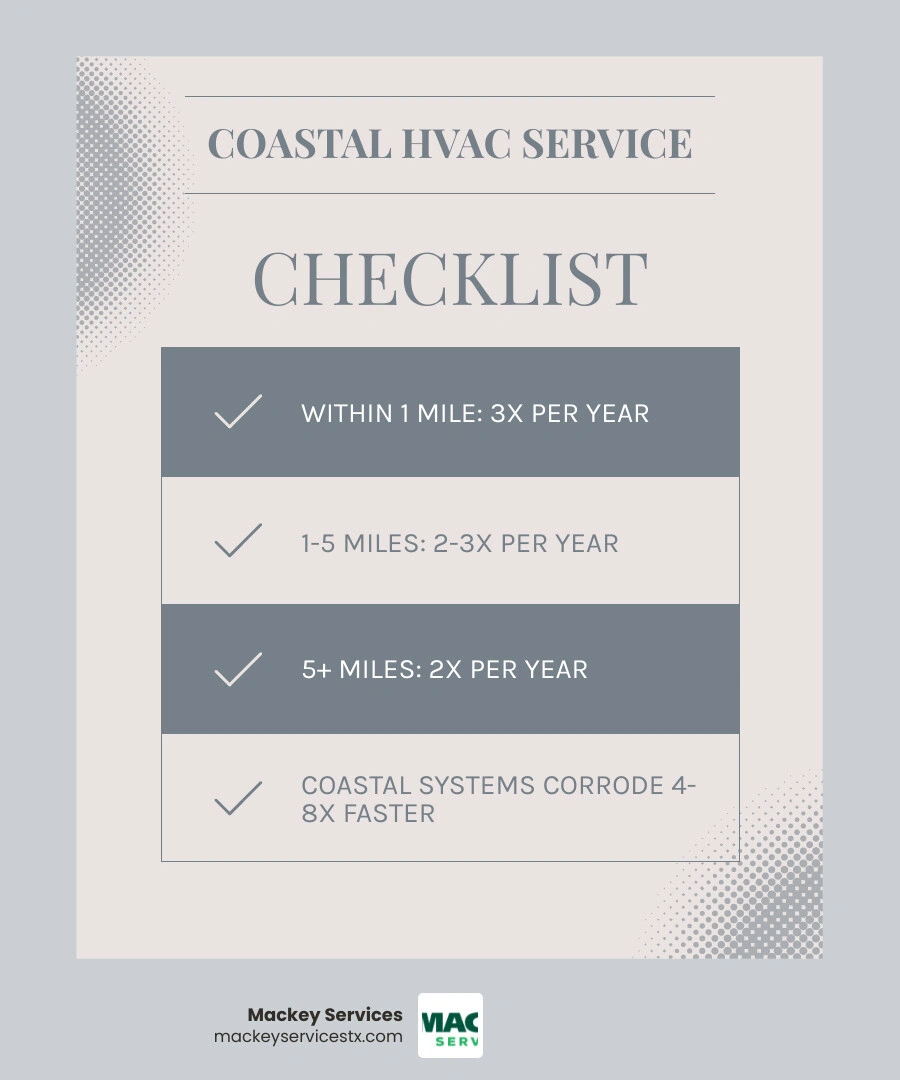
Coastal HVAC Service Frequency at a Glance
| Distance from Shore | Recommended Service Frequency |
|---|---|
| Within 1 mile | 3 times per year (spring, midsummer, fall) |
| 1–5 miles inland | 2–3 times per year |
| 5+ miles inland | 2 times per year (spring and fall) |
Most homeowners are told once a year is enough. Near the Gulf Coast, that advice can cost you thousands.
Salt air, high humidity, and sand put coastal HVAC systems under stress that inland systems simply never face. According to industry data, coastal systems can corrode 4–8 times faster than inland units — and without regular maintenance, a system that should last 15–20 years may give out in as few as 5–7 years.
For homeowners and business owners in Dickinson, League City, Friendswood, and communities along the Texas Gulf Coast, that's not a minor inconvenience. Your AC runs nearly year-round here. It works harder, wears faster, and needs more attention because of it.
Mackey Services has been helping Greater Houston area families and businesses stay ahead of these exact problems since 1992. This guide walks you through exactly what coastal living does to your HVAC system and how to protect your investment.
Why Coastal Environments Accelerate HVAC Wear and Tear
Living near the ocean is a dream for many, but for an outdoor air conditioning condenser, it is a daily battle for survival. The very things we love about the Texas Gulf Coast — the warm Gulf breezes, the relaxing sound of the waves, and the sunny days — are the primary culprits behind premature system failures.
To understand why your system needs more frequent care, we have to look at the unique environmental stressors at play. Salt air, high humidity, and blowing sand form a triple threat that silently degrades your system from the inside out. If you want to learn more about this chemical battle, read our detailed breakdown on How Salt Air and Humidity Shorten AC Lifespan.

The Science of Salt Air and Galvanic Corrosion
The primary enemy of a coastal air conditioner is salt spray. When waves crash along beaches in places like Galveston or Seabrook, they release tiny salt particles into the air. These aerosols can travel miles inland, carried by onshore winds.
Once these salt particles land on your outdoor condenser unit, they initiate a highly destructive process called galvanic corrosion. Your AC condenser is constructed of two primary metals: aluminum (used for the thin, delicate cooling fins) and copper (used for the refrigerant tubing). When salt settles on the connection points between these two different metals, it acts as an electrolyte.
In the presence of our constant coastal humidity, an electrochemical reaction occurs. The aluminum fins essentially act as a "sacrificial anode" and begin to corrode and disintegrate to protect the copper. As this happens, you will notice:
- The aluminum fins turn brittle, develop a white powdery residue, and eventually crumble away.
- Heat transfer efficiency drops dramatically because the surface area of the fins is lost.
- The system has to run longer and work harder to cool your home, driving up utility bills.
- Eventually, the copper tubing develops tiny pinhole leaks (pitting), causing refrigerant to escape.
How Often Should You Service Your HVAC Near the Coast to Prevent Lifespan Reduction?
Inland homes in drier, milder climates can easily get 15 to 20 years of reliable service out of a standard central air conditioner. Near the Texas coast, however, that lifespan is cut drastically. Without routine, specialized care, an outdoor condenser directly exposed to salt air can fail completely in just 5 to 7 years.
By increasing your service frequency, you can push that lifespan back up toward 10 to 12 years or more, even in high-exposure zones. Regular servicing allows technicians to wash away accumulated salt, apply protective barriers, and catch early signs of corrosion before they cause system-wide failures. For practical, everyday tips on keeping your system running smoothly between professional visits, explore our HVAC Maintenance Tips for Coastal Texas Homeowners.
How Often Should You Service Your HVAC Near the Coast?
When determining how often should you service your HVAC near the coast, a one-size-fits-all approach simply does not work. A home sitting directly on the water in Kemah has vastly different maintenance requirements than a home located ten miles inland in Pearland.
To help you visualize the difference in maintenance needs, we have compiled a comparison of what a system requires based on its location:
Coastal vs. Inland HVAC Maintenance Needs
| Maintenance Task | Beachfront / Marine Zone (0–1 Mile) | Near-Coastal Zone (1–5 Miles) | Inland Zone (5+ Miles) |
|---|---|---|---|
| Professional Tune-Ups | 3 times per year (Spring, Summer, Fall) | 2 to 3 times per year | 2 times per year (Spring & Fall) |
| Coil Rinsing (DIY) | Once every 1 to 2 weeks | Monthly | Quarterly (or as needed for dust) |
| Filter Changes | Every 30 to 45 days | Every 45 to 60 days | Every 60 to 90 days |
| Drain Line Flushing | Quarterly | Twice per year | Once per year |
| Anti-Corrosion Coatings | Reapply professional grade every 2 years | Reapply every 3 years | Typically not required |
Recommended Service Intervals for Beachfront vs. Inland Homes
Proximity to the shoreline is the single biggest factor in how quickly salt air will degrade your system.
- High-Exposure Zone (Within 1 Mile): If you can smell the salt air or see the water from your porch, your system is in the splash zone. We recommend a triannual service schedule. A spring visit prepares the system for the brutal summer heat, a mid-summer visit clears out heavy salt buildup and checks high-stress electrical components, and a fall visit prepares the system for winter while cleaning away summer's accumulated grime.
- Moderate-Exposure Zone (1 to 5 Miles): In towns like Dickinson and League City, you are still well within range of coastal winds and high humidity. We highly recommend servicing your system 2 to 3 times per year to prevent salt creep from slowly eating away at your coils.
- Inland Zone (5+ Miles): While you are safer from heavy salt spray, our regional humidity still forces your system to run up to 3,500 hours annually. A standard biannual service plan (once in spring, once in fall) is the gold standard here to keep efficiency high.
Investing in these routine checkups pays off in the long run. To see how preventative care saves you money, check out the Benefits of Routine AC Maintenance.
Why Heat Pumps and Mini-Splits Require More Frequent Attention
If your home utilizes a heat pump or a ductless mini-split system, regular maintenance is even more critical. Unlike standard air conditioners that get a break during our brief Texas winters, heat pumps and mini-splits work year-round.
Because they use a reversing valve to provide both heating and cooling, these systems never have an "off-season." This constant operation accelerates component wear. Furthermore, ductless mini-splits feature smaller, highly sensitive electronic components and compact outdoor coils that clog easily with salt, sand, and pet dander. If these compact coils are neglected, airflow is restricted, which can cause the system to freeze up or experience compressor failure.
Best Practices for Professional and DIY Coastal HVAC Care
Protecting your coastal HVAC system requires a partnership between you and your professional HVAC technician. While a homeowner can handle simple, routine tasks, complex electrical testing, refrigerant calibration, and deep chemical cleaning must be left to licensed professionals.
What a Professional Coastal HVAC Maintenance Visit Should Include
A standard, inland AC tune-up usually involves a quick dust-off and a basic electrical check. A true coastal maintenance visit must be far more rigorous. When our technicians perform a tune-up in coastal communities, we utilize a comprehensive checklist designed to combat marine environments:
- Detailed Coil Inspection: We inspect both the indoor evaporator coil and the outdoor condenser coil for early signs of salt pitting, "fluffing" of aluminum fins, and corrosion.
- Deep Condenser Coil Wash: We use specialized, low-pressure rinsing techniques to dissolve and wash away salt crust and sand embedded deep within the fins without bending the delicate metal.
- Electrical Component Testing: Salt air can quickly corrode electrical contacts, contactors, and capacitors. We test all electrical connections, tighten loose wires, and apply protective non-conductive coatings to prevent short circuits.
- Refrigerant Charge Verification: Low refrigerant levels force the compressor to run hotter and work harder, accelerating wear. We verify the exact charge to ensure peak operating efficiency.
- Condensate Drain Line Flushing: High humidity means your system pulls gallons of water out of the air daily. We flush the drain pan and lines to prevent algae clogs and water damage.
- Thermostat Calibration: We verify that your thermostat is communicating accurately with your system to prevent short-cycling.
We tailor our maintenance visits to the specific needs of each local community. If you live on the water, explore our localized services for:
- Air Conditioning Maintenance in Galveston
- Air Conditioning Maintenance in Seabrook
- Air Conditioning Maintenance in League City
How Homeowners Can Protect Their Coastal HVAC Systems
In between professional maintenance visits, there are several simple steps you can take to shield your outdoor unit from the elements:
- The Monthly Freshwater Rinse: This is your best DIY defense. Once a month (or weekly if you live beachfront), gently spray down your outdoor condenser unit with a standard garden hose. Always use a low-pressure fan spray pattern and spray parallel to the fins. Never use a pressure washer, as the high pressure will instantly bend and ruin the aluminum fins.
- Install a Strategic Windbreak: If your unit is directly exposed to harsh ocean winds, consider installing a physical barrier, such as a decorative fence or dense shrubbery. Ensure the barrier is placed at least 2 to 3 feet away from the unit to maintain proper airflow.
- Keep Up with Filter Changes: High humidity can make indoor air feel heavy and trap dust in your filters quickly. Check your air filters every 30 days and replace them as soon as they show signs of graying. We recommend using filters rated between MERV 8 and MERV 11 for the best balance of filtration and airflow.
- Avoid Non-Breathable Covers: Never wrap your outdoor unit in a plastic or non-breathable cover. These covers trap moisture and salt air inside, creating a humid "sauna effect" that accelerates corrosion.
To make keeping up with these tasks easy and affordable, many homeowners choose to enroll in a structured service plan. Learn more about how these plans work by reading Is an HVAC Maintenance Plan Worth It and discover how they save you money in our guide on Do HVAC Maintenance Plans Save Money in Hot Climates.
Frequently Asked Questions About Coastal HVAC Care
What are the signs that my system needs service sooner than scheduled?
Even with a consistent maintenance schedule, our coastal weather can occasionally throw a curveball. You should call for a professional inspection immediately if you notice any of the following warning signs:
- Lukewarm Airflow: If the air coming out of your vents isn't as cold as it used to be, your system may have a refrigerant leak caused by coil pitting.
- Unusual Noises: Squealing, grinding, or loud rattling noises often point to a failing fan motor or loose components degraded by salt air.
- Spiking Utility Bills: A sudden, unexplained jump in your monthly energy bill means your system is losing efficiency and running longer to cool your home.
- White Powdery Residue: If you look at your outdoor coils and see a white, crusty, or powdery substance, that is active salt corrosion eating away at your aluminum fins.
Does a standard manufacturer warranty cover salt air corrosion?
Generally, no. Most major HVAC manufacturers classify salt air corrosion, coastal rust, and wind-blown sand damage as "environmental damage" or "acts of nature." Because of this, standard warranties typically exclude these issues.
However, some manufacturers offer specialized marine-grade or coastal-specific warranties. These extended coverages almost always require documented proof of regular, professional maintenance to remain valid. If you cannot produce service records showing biannual or triannual professional care, any warranty claims for corroded coils may be denied.
How often should you service your hvac near the coast if you have a commercial property?
Commercial HVAC systems face even greater demands than residential units. They typically feature longer operating hours, handle higher occupancy loads, and must comply with strict indoor air quality standards.
For commercial properties located near the coast, we recommend quarterly HVAC service (four times per year). Regular quarterly inspections are essential to prevent sudden breakdowns that could disrupt your business operations, ruin inventory, or compromise customer comfort.
If you own or manage a business in our coastal service areas, let us help you protect your bottom line. Read more about our specialized commercial services:
Conclusion
Living near the Texas Gulf Coast is a wonderful experience, but it requires a proactive approach to home maintenance. When it comes to the question of how often should you service your HVAC near the coast, the evidence is clear: standard once-a-year maintenance plans simply won't cut it. To protect your system from the relentless assault of salt air, heavy humidity, and blowing sand, a biannual or triannual professional maintenance schedule is an absolute necessity.
Since 1992, Mackey Services has been the trusted name for home comfort in Dickinson, League City, Friendswood, and the surrounding communities. As a family-owned business with over three decades of local experience, we understand the unique challenges of our coastal climate. Whether you need a routine seasonal tune-up, custom ductwork fabrication, or 24/7 emergency AC repair, our licensed technicians are ready to deliver reliable, friendly service.
Don't wait for the summer heat to catch you by surprise. Schedule your coastal AC maintenance with Mackey Services in Dickinson today!
Ready for a better day?
One call handles it all — HVAC, electrical, and generators across the Texas Gulf Coast. Less to pay. Better day. That's the Mackey way.
Mon–Fri: 7 AM – 8 PM · Sat: 8 AM – 5 PM · Licensed & insured · #TACLA 112769C · #TECL 558211