
The Pros and Cons of Replacing Sagging Flex Ducts with Rigid Metal
Compare the pros and cons of replacing sagging flex ducts with rigid metal. See why upgrading your ductwork can permanently solve late summer hot spots.
Is Your Ductwork the Hidden Culprit Behind Your Hot Spots?
Most homeowners assume that when a house refuses to cool down, the air conditioning unit itself is failing. However, in our years of inspecting Dickinson, TX attics, the team at Mackey Services has found that the real culprit is often hiding directly above your ceiling. When evaluating the pros and cons of replacing sagging flex ducts with rigid metal, you quickly realize that it is a common myth that all ductwork performs exactly the same as long as it is connected to a working AC. The truth is that the physical condition of your air distribution system dictates how much conditioned air actually reaches your living space. When you are dealing with late August peak heat, even a perfectly functioning compressor cannot overcome the severe airflow restrictions caused by deteriorating, sagging flexible ductwork.
The core decision point for many homeowners facing chronic hot spots is whether to continually patch and rehang failing flex ducts or to make a definitive upgrade to insulated rigid metal for lasting performance. Evaluating this choice requires looking past the thermostat and understanding what happens in the harsh environment of an unconditioned space. To ensure your air conditioning system delivers the comfort you expect, it helps to understand the physics of airflow and the long-term durability of the materials carrying your air.
The Physics of Airflow: Why Flexible Ducts Struggle in Extreme Heat
To understand why specific rooms never seem to cool down, you have to look at the mechanics of friction loss and thermal degradation. Flexible ductwork is constructed using a thin mylar jacket stretched over a wire helix, surrounded by a layer of fiberglass insulation. While this design is highly adaptable, it is exceptionally vulnerable to extreme thermal stress. With extreme Gulf Coast humidity and brutal 130°F+ attic temperatures beating down on the outer jacket day after day, the plastic components slowly become brittle, and the adhesive holding the helix together begins to fail.
The Impact of Sagging on Friction Loss
According to standard ASHRAE fundamentals on friction loss, air travels best in a straight, smooth line. When flexible ducts lose their structural integrity, they begin to droop between their suspension straps. This sagging creates literal hills and valleys that the conditioned air must climb over and push through. Every dip and bend acts as a choke point, significantly increasing static pressure and robbing the air of its velocity before it ever reaches distant rooms.
Condensation and Sweating Risks
Beyond physical sagging, compromised flex ducts face another serious threat in high-humidity environments. If the outer vapor barrier degrades or tears, warm, moist attic air comes into contact with the cold inner core of the duct. This causes the ductwork to "sweat." Over time, this condensation saturates the surrounding insulation, making the duct heavier (which accelerates sagging) and completely ruining its thermal resistance. If you are tired of battling these physical limitations, reaching out for professional HVAC services to evaluate your system's static pressure is the best first step.
Identifying the Symptoms of Sagging and Failing Ductwork
The physical deterioration happening in the dark corners of your attic always translates into very noticeable symptoms inside your living space. For Dickinson, TX area homes, these warning signs usually become impossible to ignore right as the most intense late-summer weather sets in. If you are experiencing any of the following issues, your ductwork is likely failing:
- Severe hot spots: Specific rooms, usually those furthest from the indoor air handler, consistently feel warmer than the rest of the house and never seem to cool down.
- Noticeably restricted airflow: The air barely trickles out of the vents. Our team at Mackey Services frequently encounters this exact issue during late-summer service calls as families prepare for the back-to-school transition, noticing severely restricted airflow whenever interior doors are closed. In one recent case, the original return was located on the far end of the home, forcing the system to push air through aging, deteriorating pathways. After replacing the old, inefficient ducts and adding a second return line to balance the pressure, the overall AC efficiency and airflow throughout the home improved dramatically.
- Increased dust and humidity: Tears in the ductwork pull dusty, unconditioned attic air directly into your home, elevating indoor humidity levels and triggering allergies. Addressing this is a critical way to improve your indoor air quality.
- Higher energy consumption: Your system runs constantly, working overtime to push air through restricted pathways, which drives up your monthly utility usage without improving your comfort.
The Pros and Cons of Flexible Ductwork (The Status Quo)
When deciding how to address airflow issues, it is important to objectively evaluate the status quo. Replacing old flex duct with new flex duct remains the most common choice in residential construction, primarily due to its accessibility. However, it comes with inherent trade-offs, especially when subjected to late August peak heat.
The Advantages of Flex Duct
- Lower initial investment: The materials are highly mass-produced, and the installation process requires fewer specialized tools, making the upfront commitment lower.
- Easier routing: The flexible nature of the material allows installers to easily snake it around complex attic obstacles, plumbing pipes, and low roof pitches.
- Faster installation time: Because it does not require custom fabrication or precise measuring for every turn, standard replacements can often be completed relatively quickly.
The Disadvantages of Flex Duct
- Inherently higher friction loss: Even when installed perfectly, the ridged interior of a flexible duct creates more resistance than smooth metal. If it is not stretched perfectly tight, this friction loss multiplies rapidly.
- Highly susceptible to degradation: UV exposure from attic vents, extreme heat, and time cause the outer jacket to turn brittle and disintegrate.
- Vulnerable to physical damage: Rodents and pests can easily chew through the mylar and fiberglass, creating massive air leaks that are difficult to spot.
The Pros and Cons of Rigid Metal Ductwork (The Upgrade)
Upgrading to rigid sheet metal ductwork represents a fundamental shift in how your home manages air distribution. Instead of relying on a soft, pliable tube, you are installing a permanent structural pathway for your conditioned air. While it is incredibly effective against 130°F+ attic temperatures, it requires a completely different level of craftsmanship.
The Advantages of Rigid Metal
- Maximum airflow efficiency: The smooth interior surface of galvanized steel allows air to glide with minimal friction loss, ensuring that distant rooms receive the same powerful airflow as rooms right next to the unit.
- Decades of durability: Sheet metal does not sag, droop, or become brittle over time. It maintains its exact shape and structural integrity regardless of the thermal conditions around it.
- Impenetrable to pests: Rodents, raccoons, and insects cannot chew through steel, completely eliminating the risk of pest-related air leaks.
The Disadvantages of Rigid Metal
- Higher upfront investment: The material costs are greater, and the labor required to measure, cut, seal, and insulate custom metal fittings is intensive.
- Requires heavy exterior insulation: Because metal transfers heat rapidly, the entire system must be painstakingly wrapped in thick insulation to prevent energy loss and sweating.
- Requires precise custom fabrication: Every turn, elbow, and transition must be custom-built to fit your specific attic layout, which takes significantly more time and expertise. This level of precision is exactly what your system needs when keeping up with a 100-degree Texas afternoon.
Side-by-Side Comparison: Flex vs. Rigid Metal in Harsh Attics
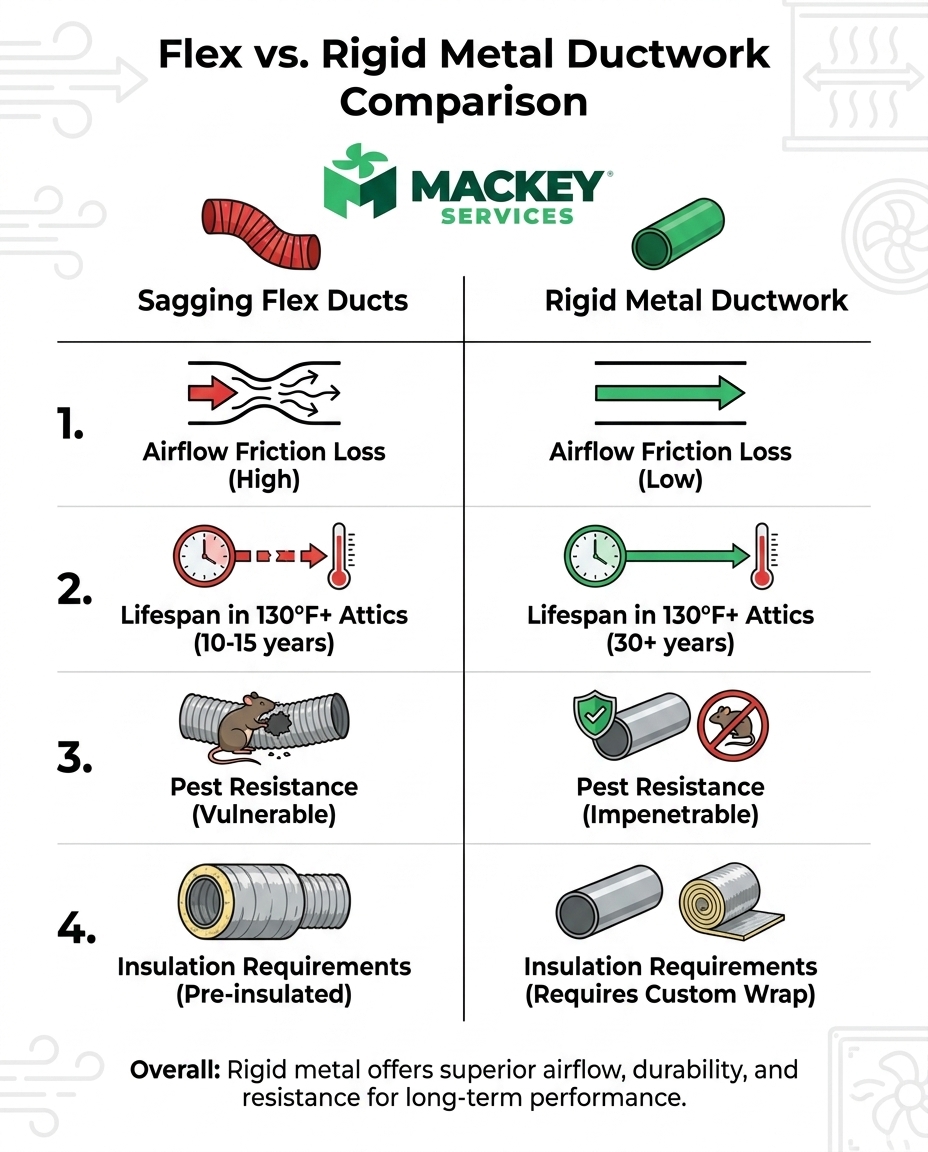
To help you weigh your options, here is a quick, scannable comparison of how these two materials perform across key metrics in Dickinson, TX area homes.
| Performance Metric | Flexible Ductwork | Rigid Metal Ductwork |
|---|---|---|
| Airflow Efficiency | High friction loss, especially if sagging | Low friction loss, smooth continuous airflow |
| Lifespan in Unconditioned Space | Shorter lifespan, prone to structural sagging | Decades of structural integrity, no sagging |
| Insulation Needs | Pre-insulated, but outer jacket is vulnerable | Requires heavy, custom-wrapped R-8 minimum |
| Maintenance & Durability | Prone to tears, crushing, and pest damage | Easy to clean, crush-proof, and pest-proof |
When Does Upgrading to Rigid Metal Make Sense?
Choosing to upgrade your ductwork is a significant decision. While flex duct certainly has its place in residential construction, there are specific scenarios where transitioning to rigid metal is the most logical path forward. If you are planning to stay in your property long-term and want to maximize your HVAC efficiency, the long-term energy savings and improved comfort often justify the initial setup.
Solving Chronic Hot Spots
Upgrading is crucial for homes suffering from chronic, severe hot spots that standard air balancing cannot fix. If a specific bedroom is consistently ten degrees warmer than the hallway during late August peak heat, and the existing flex duct is fully stretched but still failing to deliver volume, a smooth metal run can dramatically increase the velocity of the air reaching that room.
Exploring Alternative Targeted Cooling
It is also important to discuss situations where alternative targeted cooling might be preferred over a full attic duct replacement. If only one room (like a sunroom or a converted garage) is struggling, and the rest of the ductwork is in pristine condition, it may be more efficient to bypass the central ductwork entirely. In these edge cases, exploring ductless mini split systems can provide pinpoint cooling without the need to redesign your entire attic air distribution layout.
The Importance of Professional Installation and Heavy Insulation
If you decide that rigid metal is the right choice for your home, the execution of the installation is paramount. This is strictly professional-level work; DIY attempts often lead to severe condensation issues, air leaks, and massive system damage. When dealing with 130°F+ attic temperatures, the margin for error is zero.
- Proper Sizing and Securing: Rigid metal must be meticulously sized to match the static pressure requirements of your blower motor. Furthermore, our installation team at Mackey Services custom-designs, properly sizes, rigidly secures, and heavily insulates metal systems specifically engineered to survive brutal coastal Texas attic conditions. Proper strapping prevents vibration, rattling, and noise transfer through the ceiling.
- Mastic Sealing: Every joint, elbow, and seam must be sealed with professional-grade mastic—not just standard duct tape. Improperly sealed metal ducts will leak highly conditioned air directly into the attic, wasting energy and depressurizing your home.
- Heavy Exterior Insulation: Bare metal in a hot attic will immediately cause the cold air inside to absorb heat, and the exterior of the pipe will sweat profusely. The system requires a minimum of R-8 insulation wrapped securely and taped at every seam to prevent massive energy loss and destructive condensation.
Weighing Your Ductwork Options for Lasting Comfort
When it comes down to it, while flexible ductwork has its place as a quick and accessible material, rigid metal offers superior, lasting airflow that simply cannot be matched by plastic and wire. Addressing failing ductwork is the absolute key to eliminating late-summer hot spots and ensuring your AC unit isn't working harder than it needs to.
If you suspect that sagging ducts are robbing your Dickinson, TX area home of its comfort, the smartest move is to let our experts at Mackey Services perform a professional evaluation. A thorough static pressure test and visual inspection will determine the best path forward for your specific layout. Reach out to local experts to review your system, weigh your options, and finally achieve the reliable, balanced cooling your home deserves.
Frequently Asked Questions
Is rigid metal ductwork better for airflow than flex duct?
Yes, rigid metal ductwork provides significantly better airflow than flexible ducting. The interior surface of galvanized steel is completely smooth, which minimizes friction loss and allows air to travel at a higher velocity. In contrast, the ribbed interior of flex duct creates resistance, which is magnified if the duct sags or bends sharply.
Why do flexible ducts sag over time?
Flexible ducts sag because the materials degrade under extreme thermal stress and gravity. The thin wire helix and plastic mylar jacket weaken after years of exposure to extreme attic heat. As moisture and dust accumulate inside, the added weight pulls the ductwork down between its suspension straps, creating severe choke points.
Does rigid ductwork prevent hot spots?
Rigid ductwork is highly effective at preventing hot spots caused by poor air distribution. Because it does not sag or crush, it ensures a consistent, unrestricted volume of conditioned air reaches distant rooms. However, your HVAC system must still be properly sized and balanced to eliminate hot spots entirely.
Can you mix rigid and flexible ductwork in the same attic?
Yes, mixing the two materials is a very common and effective hybrid approach. Installers often use rigid metal for the main trunk lines to maintain high air velocity over long distances, and then use short, properly stretched runs of flexible duct for the final branches connecting to the ceiling registers. This balances airflow efficiency with installation flexibility.
How long does flexible ductwork last in an unconditioned attic?
In a harsh, unconditioned attic, standard flexible ductwork typically lasts between 10 and 15 years before significant degradation occurs. Extreme heat, high humidity, and UV exposure from roof vents accelerate the breakdown of the outer vapor barrier. Once the jacket becomes brittle and tears, the ductwork must be replaced to maintain system efficiency.
What R-value insulation is required for rigid ductwork?
In unconditioned spaces like attics, rigid ductwork requires a minimum of R-8 insulation to perform efficiently and safely. This thick layer of custom-wrapped fiberglass prevents the cold metal from absorbing ambient heat and stops warm, humid air from condensing on the exterior of the duct. Proper insulation is essential to prevent energy loss and moisture damage.
Ready for a better day?
One call handles it all — HVAC, electrical, and generators across the Texas Gulf Coast. Less to pay. Better day. That's the Mackey way.
Mon–Fri: 7 AM – 8 PM · Sat: 8 AM – 5 PM · Licensed & insured · #TACLA 112769C · #TECL 558211