
Why Coastal Texas Homes Need Specialized AC Condenser Coatings
Standard aluminum AC fins crumble quickly in Galveston County's aggressive salt air. Upgrading to epoxy-coated coils is a critical survival tactic to prevent premature system failure.
The Hidden Threat Destroying Coastal Texas Air Conditioners
Your relatively new outdoor cooling unit is already showing signs of rust, and you are likely wondering why coastal Texas homes need specialized AC condenser coatings to survive. The culprit behind this rapid decay is not a mechanical defect or a lack of basic homeowner care. Instead, it is the aggressive, salt-laden air you breathe every day. For properties located near the water, standard air conditioning equipment faces an invisible, constant attack from the moment it is installed.
To protect your investment, you need the right air conditioning systems backed by proactive preventative AC maintenance.
Our technicians at Mackey Services constantly see the deep frustration of premature AC failure in these coastal micro-climates. You might walk outside to find the thin metal fins on your outdoor unit turning to white powder or crumbling away entirely. Upgrading to coated coils is not just an optional upsell pitched by a technician; it is a critical survival tactic for your HVAC equipment. Standard aluminum fins are simply not designed for constant exposure to airborne chlorides.
In our years of serving the local community, we have learned to act as regional truth-tellers for our customers. We constantly validate the frustrations of homeowners who feel like their equipment should last longer. The reality is that the specific combination of extreme humidity and salt spray unique to the Texas Gulf Coast creates an incredibly hostile environment. Specifically, our team sees this aggressive degradation firsthand on a daily basis across Galveston County beachfront and Dickinson TX bayou properties. Standard out-of-the-box equipment is built for inland climates, leaving unprotected coastal units completely vulnerable to the elements.
The Science of Galvanic Corrosion in Gulf Coast Environments
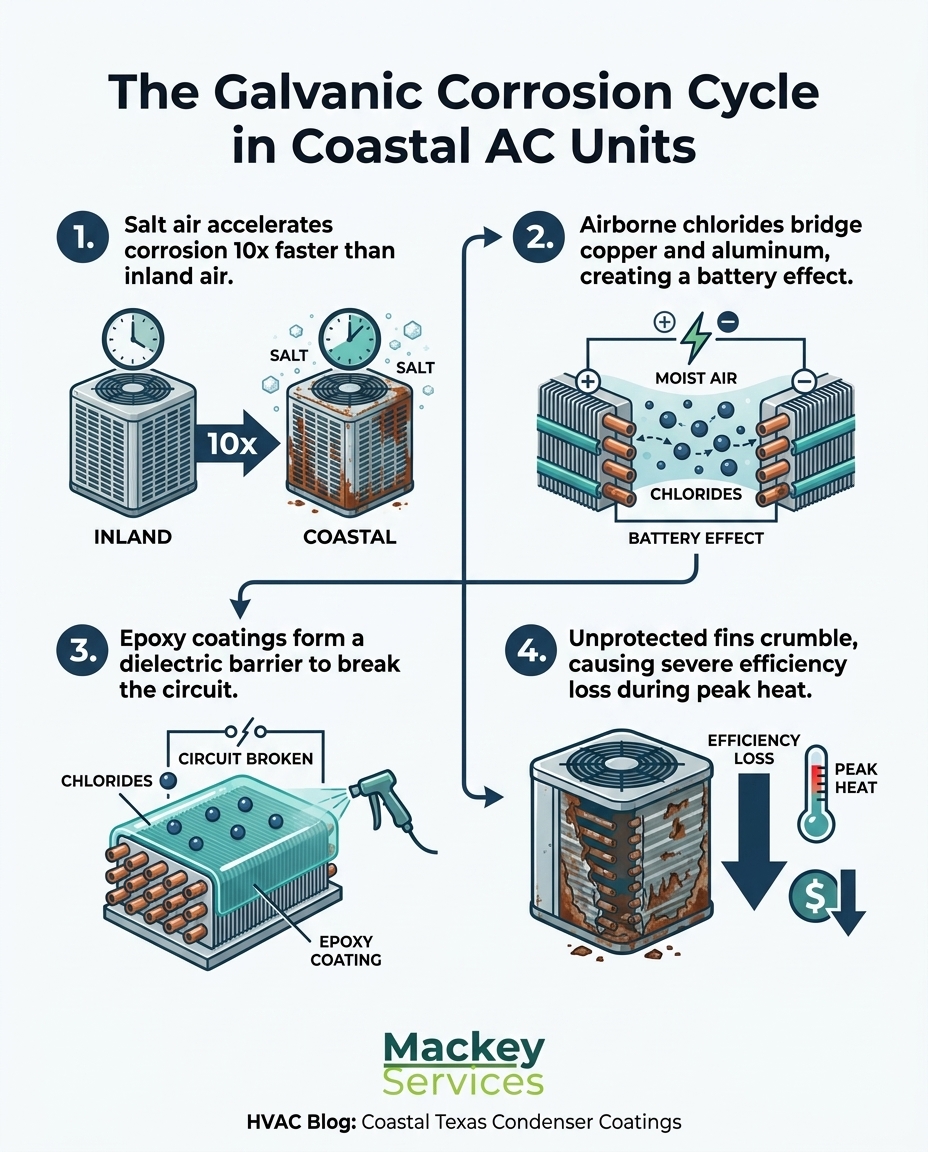
To understand why outdoor units fail so quickly here, you have to look at the specific chemical reactions happening inside the equipment. The primary mechanism destroying your condenser is known as galvanic corrosion. This is a battery-like effect that occurs whenever two dissimilar metals come into contact with an electrolyte. In your air conditioner, the copper refrigerant tubes and the aluminum cooling fins represent the two dissimilar metals.
In a dry, inland environment, these metals can coexist for years without issue. However, the constant brackish moisture blowing in off the water acts as the perfect electrolyte, bridging the gap between the copper and aluminum. When you combine this with a Texas Gulf Coast high-humidity summer, the corrosion process accelerates rapidly. In fact, salt-laden air can accelerate metal corrosion up to ten times faster than what you would see in a standard inland environment.
Understanding the best HVAC practices for coastal homes requires acknowledging this accelerated timeline. Our team typically sees standard aluminum condenser fins begin showing significant pitting and degradation within just a few months of exposure to coastal salt spray.
Why Aluminum and Copper React to Salt Air
The interaction between the copper coils and the aluminum fins is a well-documented scientific process. Because copper is a more noble metal than aluminum, the aluminum acts as a sacrificial anode when an electrolyte is introduced.
• The chloride bridge: Airborne chlorides from salt spray settle on the metal surfaces, drawing in moisture from the humid air and creating a highly conductive liquid layer.
• The electron transfer: Electrons begin to flow from the aluminum fins to the copper tubing, literally stripping the aluminum away at a microscopic level.
• The physical symptoms: Homeowners will first notice a chalky, white powder forming on the fins. Shortly after, the fins become brittle and begin to crumble off the unit entirely, leaving the copper tubing completely exposed.
Why National Manufacturer Lifespan Estimates Fail Locally
One of the most common complaints our Dickinson TX service crews hear is, "My AC is only a few years old, why is it rusting out already?" It is a completely valid question, especially when you read the documentation that came with the unit. National organizations like ASHRAE publish equipment life expectancy charts suggesting that a standard air conditioner should last 15 years or more. However, those estimates assume the equipment is operating in a mild, inland, non-corrosive environment.
In our experience replacing failed units, those factory standards are entirely insufficient for our local climate. Proximity to the Gulf of Mexico or the brackish waterways drastically alters the survival rate of unprotected equipment. A unit installed on a Galveston County beachfront and Dickinson TX bayou properties faces daily environmental stressors that an identical unit in Dallas or Austin will never experience.
At Mackey Services, we understand that national lifespan estimates fail locally because they do not account for airborne chlorides. We validate the need for localized solutions rather than relying on out-of-the-box national standards that leave homeowners footing the bill for premature replacements.
• Airborne Chlorides — National Inland Expectation: Minimal to none — Coastal Texas Reality: Constant daily exposure from salt spray and brackish wind
• Average Humidity — National Inland Expectation: Moderate, allowing metal to dry — Coastal Texas Reality: Consistently high, keeping corrosive electrolytes active
• Expected Fin Lifespan — National Inland Expectation: 12 to 15+ years — Coastal Texas Reality: Visible pitting and crumbling often within 2 to 5 years
• Corrosion Rate — National Inland Expectation: Baseline standard — Coastal Texas Reality: Up to 10x faster than the national average
How Peak Summer Heat Exposes Corroded Systems
The physical degradation of your condenser is not just a cosmetic issue; it directly impacts your system's ability to cool your home. The thin aluminum fins on your outdoor unit have a very specific job: they increase the surface area of the coil so the system can effectively reject the heat it absorbed from inside your house.
As those fins corrode, turn to white powder, and crumble away, the system loses its primary mechanism for releasing heat. This loss of efficiency becomes painfully obvious during the peak heat of a Texas Gulf Coast high-humidity summer. When July temperatures climb into the upper 90s and the humidity makes it feel well over 100 degrees, our emergency dispatch logs fill up with calls regarding AC units with missing fins that simply cannot keep up with the cooling demand.
Because the system cannot reject heat properly, the internal refrigerant pressures rise. A pattern we see often is that this forces the compressor to work much harder and run much longer just to maintain a basic level of comfort indoors. If your system is struggling under heavy summer loads, exploring specialty HVAC solutions tailored to coastal environments is a necessary step to restore your cooling power.
The Chain Reaction of Efficiency Loss
When galvanic corrosion destroys your condenser fins, it triggers a cascade of mechanical and financial problems for your household.
• Reduced heat rejection: Less fin surface area equals less capacity to move heat from the refrigerant into the outside air.
• Compressor strain: Higher refrigerant pressures force the compressor to operate outside of its designed parameters, leading to overheating and potential mechanical failure.
• Skyrocketing utility bills: Because the system has to run continuously to achieve the same cooling effect, your energy consumption spikes dramatically during the hottest months.
• Mid-summer breakdowns: The combination of extreme July heat, high pressure, and constant operation significantly increases the risk of a total system failure right when you need it most.
The Definitive Solution: Epoxy-Coated AC Coils
The only proven way to stop the rapid degradation of your outdoor unit is to physically separate the salt air from the vulnerable metals. This is achieved through specialized epoxy coatings. An epoxy coating acts as a robust dielectric barrier—meaning it does not conduct electricity. By applying this barrier to the condenser coil, you effectively break the electrical circuit between the dissimilar metals, stopping galvanic corrosion in its tracks.
These specialized coatings are engineered specifically for harsh coastal and industrial environments. They are not the same as standard spray paints or basic rust inhibitors you might find at a hardware store. We always emphasize to our customers that professional-grade epoxy coatings must be applied meticulously to ensure 100% coverage of the fins and the copper tubing. If even a small section of the metal is left exposed, the galvanic corrosion process will begin at that pinpoint and spread underneath the coating.
For homeowners managing Galveston County beachfront and Dickinson TX bayou properties, we highly recommend choosing a factory-applied or professionally applied aftermarket epoxy coating as the definitive defense mechanism against the elements.
How the Dielectric Barrier Works
Understanding the mechanics of the epoxy barrier helps clarify why it is so highly recommended for our region.
1. Physical shielding: The cured epoxy forms a hardened, impenetrable shell over the aluminum fins and copper tubes, physically blocking airborne chlorides and moisture from touching the metal.
2. Electrical isolation: Because the coating is a dielectric material, it prevents the electron transfer required for the battery-like corrosion process to occur.
3. Thermal conductivity retention: High-quality HVAC epoxy coatings are applied in an ultra-thin layer (often less than 3 mils thick), ensuring they maintain the structural integrity of the fins without insulating the metal and blocking heat transfer.
Are Epoxy Coatings a Luxury or a Coastal Necessity?
When reviewing a quote for a new air conditioning system, it is common to wonder if specialized coatings are truly necessary. We readily acknowledge that for a home located a hundred miles inland, an epoxy-coated coil might be an unnecessary luxury. Inland environments simply do not have the airborne chlorides required to cause rapid galvanic corrosion.
However, the rules change entirely when you live near the water. For properties situated near salt water or brackish bayous, an epoxy coating is a critical necessity to protect your HVAC investment. Without it, you are essentially placing a ticking clock on your new equipment. Standard maintenance alone, while highly important, cannot stop galvanic corrosion without a physical barrier in place. Rinsing the coils can help remove surface salt, but it cannot reverse the chemical reaction once it begins.
At Mackey Services, our team takes a firm stance on this issue because we have seen standard units fail far too often across our Coastal Texas service areas. We focus on long-term value and system survival. Recommending a coated coil is about ensuring your equipment actually reaches the 12-to-15-year lifespan you expect, rather than rusting out after a few harsh seasons of a Texas Gulf Coast high-humidity summer.
Frequently Asked Questions About Coastal AC Protection
Do I need a special AC for a beach house or coastal property?
Yes, homes located on the coast require AC units with specialized protective features to survive the harsh environment. Standard units use unprotected aluminum fins that corrode rapidly when exposed to salt air. For Galveston County beachfront and Dickinson TX bayou properties, investing in an AC unit with an epoxy-coated condenser coil is highly recommended to prevent premature system failure and maintain energy efficiency.
How do you protect an AC unit from salt air?
The most effective way to protect an AC unit from salt air is by applying a professional-grade epoxy coating to the condenser coils. This coating acts as a dielectric barrier, preventing salt and moisture from triggering galvanic corrosion between the copper and aluminum components. Additionally, regularly rinsing the outdoor unit with fresh water helps remove accumulated salt residue, though rinsing alone cannot replace the need for a physical protective coating.
What exactly is an epoxy coated AC coil?
An epoxy-coated AC coil is a standard condenser coil that has been treated with a specialized, non-conductive chemical barrier. This ultra-thin layer of epoxy is applied either at the factory or by a certified professional before installation. The coating is specifically engineered to block airborne chlorides and moisture from touching the bare metal, effectively stopping rust and corrosion without insulating the coil or reducing the system's ability to release heat.
How long do standard AC units last on the Texas coast without protection?
Without specialized protection, standard AC units on the Texas coast often begin showing severe signs of corrosion within two to five years. While national averages suggest an air conditioner should last 15 years, the aggressive salt spray and high humidity near the Gulf drastically reduce that lifespan. Once the aluminum fins begin to crumble, the system loses efficiency rapidly, often leading to total compressor failure well before the decade mark.
Can standard AC maintenance prevent galvanic corrosion?
Standard AC maintenance is critical for overall system health, but it cannot prevent galvanic corrosion on its own. Rinsing the coils and changing filters will keep the system running smoothly, but unless there is a physical dielectric barrier separating the dissimilar metals from the salt air, the chemical reaction will still occur. Professional maintenance must be paired with an epoxy coating for true coastal protection.
Protect Your Investment Against the Texas Salt Air
Understanding the unique challenges of your local environment is the first and most important step in protecting your home's cooling system. The aggressive salt air and high moisture levels along the coast demand a proactive approach to HVAC care. Standard equipment simply cannot withstand the constant barrage of airborne chlorides without suffering severe efficiency losses and premature failure.
Fortunately, you do not have to settle for equipment that rusts away after a few seasons. With the right specialized equipment—specifically epoxy-coated condenser coils—you can achieve long-lasting comfort and system reliability, even through a brutal Texas Gulf Coast high-humidity summer. We highly encourage you to consult with our local experts about your specific property's exposure levels. By combining the right protective technology with consistent preventative AC maintenance, you can secure your investment and keep your home comfortable for years to come.
Ready for a better day?
One call handles it all — HVAC, electrical, and generators across the Texas Gulf Coast. Less to pay. Better day. That's the Mackey way.
Mon–Fri: 7 AM – 8 PM · Sat: 8 AM – 5 PM · Licensed & insured · #TACLA 112769C · #TECL 558211