
The Ultimate Guide to the 5000 Dollar Rule for AC Replacement
Learn how the 5000 dollar rule for ac replacement helps Gulf Coast homeowners decide whether to repair or replace their aging AC system.
Is Your AC Worth Fixing? Here's What the 5000 Dollar Rule Says
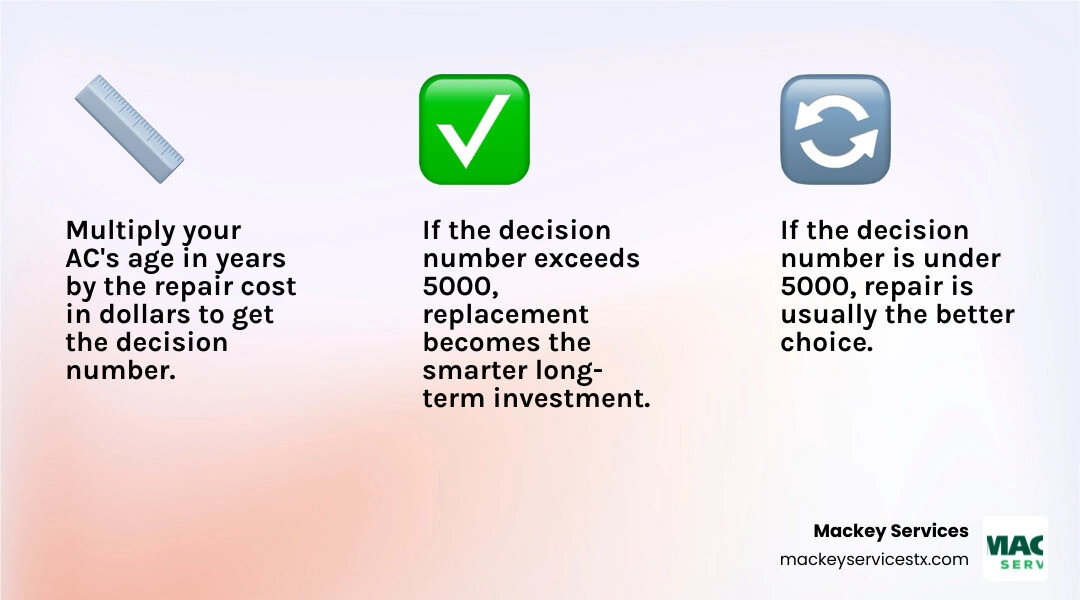
The 5000 dollar rule for AC replacement is one of the simplest tools homeowners have for answering a frustrating question: should I fix this thing or just replace it?
Here's how it works at a glance:
The Formula:
AC Age (years) × Repair Cost ($) = Decision Number
- Under $5,000 → Repair is usually the smarter move
- Over $5,000 → Replacement is likely the better investment
Quick Examples:
| AC Age | Repair Cost | Decision Number | Recommendation |
|---|---|---|---|
| 5 years | $400 | $2,000 | Repair |
| 10 years | $600 | $6,000 | Replace |
| 12 years | $500 | $6,000 | Replace |
| 8 years | $400 | $3,200 | Repair |
That's the core idea — but the math alone doesn't tell the whole story, especially here in the Greater Houston area where summer heat, coastal humidity, and salt air push AC systems harder than almost anywhere else in the country.
If your AC just broke down on a sweltering Dickinson afternoon and a technician handed you a repair quote, the last thing you want is to make a rushed, expensive mistake. This guide walks you through exactly how to use the rule, when to trust it, and when other factors should carry more weight in your decision.
What Is the 5000 Dollar Rule for AC Replacement?
When your air conditioner breaks down in the middle of a Texas summer, the pressure to make a fast decision is incredibly real. You are hot, your family is uncomfortable, and you are staring at a repair quote that makes your stomach sink. In these high-stress moments, it is easy to make an emotional choice rather than a financially sound one.
This is where the 5000 dollar rule for ac replacement comes in. It serves as an objective, numbers-based decision framework designed to take the guesswork and emotion out of the equation.
At its core, this rule calculates a "risk-adjusted cost" for keeping your current system. It recognizes that a repair on an older system carries a much higher risk of subsequent failures than the same repair on a newer, more reliable system. By using system age as a mathematical multiplier, the rule ensures that you do not continuously throw good money after bad.
If you are currently sitting on a repair quote and wondering which path to take, we highly recommend reading our detailed breakdown on Should I Repair or Replace My AC to help weigh your options.
Calculating the 5000 Dollar Rule for AC Replacement
To calculate your personal decision number, you only need two pieces of information: the exact age of your outdoor condensing unit in years, and the written repair quote from a licensed HVAC professional.
The formula is incredibly straightforward:
Age of the Unit (Years) × Estimated Cost of Repair ($) = Decision Number
Once you have your Decision Number, compare it to the $5,000 threshold:
- If the result is below $5,000: The math suggests that repairing the unit is still a reasonable, cost-effective option. The system likely has enough reliable service life left to justify the cost of the fix.
- If the result is above $5,000: The math indicates that the system is entering a phase of rapid decline. Investing in a repair is highly likely to be a short-term band-aid on a system that will require more repairs soon. In this scenario, replacing the unit is generally the smarter financial investment.
Real-World Examples of the Formula in Action
Let’s look at how this plays out for homeowners in our local communities like League City, Friendswood, and Galveston:
| Scenario | System Age | Repair Type & Cost | Calculation | Decision Number | Recommendation |
|---|---|---|---|---|---|
| Scenario A | 5 Years Old | Minor Capacitor Repair ($200) | 5 × 200 | $1,000$ | Repair |
| Scenario B | 10 Years Old | Fan Motor Replacement ($600) | 10 × 600 | $6,000$ | Replace |
| Scenario C | 12 Years Old | Evaporator Coil Leak Repair ($500) | 12 × 500 | $6,000$ | Replace |
| Scenario D | 8 Years Old | Blower Motor Repair ($400) | 8 × 400 | $3,200$ | Repair |
| Scenario E | 10 Years Old | Major Compressor Failure ($1,800) | 10 × 1800 | $18,000$ | Replace |
As you can see, the age of the unit acts as a powerful multiplier. A $600 repair on a 5-year-old system yields a decision number of $3,000, making it a clear candidate for repair. That exact same $600 repair on a 10-year-old system yields a decision number of $6,000, tipping the scales heavily toward replacement.
Why System Age and Coastal Climate Matter
While the 5000 dollar rule for ac replacement is an excellent baseline, it is crucial to understand why system age carries so much weight. As air conditioners age, they naturally lose efficiency, their mechanical components wear down, and they become more expensive to run.
However, for those of us living along the Gulf Coast—from Galveston and Texas City up to Dickinson and League City—our local climate adds a massive layer of physical stress to these systems. Coastal elements accelerate the aging process, meaning a system's chronological age might not always match its "wear-and-tear age."
To dive deeper into this local phenomenon, check out our guide on How Long Does an AC System Last on the Gulf Coast.
Average Lifespan of Gulf Coast Air Conditioners
Nationally, the average lifespan of a central air conditioner is typically cited as 15 to 20 years. However, in our region, a realistic lifespan for a well-maintained central AC is closer to 10 to 15 years.
Our exceptionally long, blistering cooling seasons—often stretching from March all the way through November—mean local systems log double or triple the annual operating hours of units in northern states. This heavy-duty usage shortens the operational lifespan of even the highest-quality brands.
When you are trying to decide if your system is nearing the end of its useful life, we recommend reviewing our article on When Should You Replace Your AC in a Coastal Climate.
The Impact of Salt Air and Humidity on System Longevity
Living near the Gulf means our air is thick with moisture and corrosive salt spray. This combination is incredibly tough on outdoor HVAC equipment:
- Galvanic Corrosion: Salt air acts as an electrolyte, accelerating rust and corrosion on the outdoor condenser's delicate aluminum fins and copper tubing. This corrosion restricts heat transfer, forcing the compressor to work harder and run hotter.
- Sustained Humidity: High humidity forces your system to spend a massive amount of energy removing moisture from the air before it can effectively lower the indoor temperature. This constant moisture keeps internal components damp, increasing the risk of electrical shorts and rust.
Because our climate is so punishing, regular preventative maintenance is the single most effective way to protect your investment. To understand how to keep your system running longer, read about the Why Regular Maintenance Gives Your HVAC System a Longer Lifespan and check out A Homeowner's Guide to Extending Your HVAC System's Lifespan.
Crucial Factors Beyond the Mathematical Formula
While the math behind the 5000 dollar rule for ac replacement is highly reliable, it is a guideline rather than an absolute law. There are several critical factors that the formula cannot capture.
If your air conditioner is struggling to keep your home comfortable, or if you are noticing uneven cooling and skyrocketing energy bills, there may be deeper issues at play. Before making a final decision, we suggest checking out these helpful resources: 7 Signs You Need a New AC and 7 Signs It's Time for a New Air Conditioner Greater Houston.
Refrigerant Phase-Outs and Environmental Regulations
One of the biggest limitations of a simple mathematical formula is that it does not account for the availability of the chemical refrigerant running through your system.
- R-22 Refrigerant (Freon): If your AC was installed before 2010, there is a very high chance it uses R-22. The EPA completely phased out the production and import of R-22 in 2020. Today, the only available supply comes from recycled or reclaimed sources. As a result, the cost to recharge an R-22 system after a leak has skyrocketed, making even minor repairs on these older systems financially impractical.
- R-410A Transition: The industry is currently undergoing another major transition. As of 2025 and moving into 2026, environmental regulations are phasing out R-410A in favor of newer, low-GWP (Global Warming Potential) refrigerants like R-454B and R-32. While R-410A will remain available for servicing existing systems for years to come, parts and refrigerant costs for these systems will gradually rise over the next decade.
Energy Efficiency Standards and SEER2 Savings
Older air conditioners operate at much lower efficiency levels than modern systems. In 2023, the Department of Energy implemented strict new SEER2 (Seasonal Energy Efficiency Ratio 2) standards.
Replacing a 10-to-12-year-old system (which might have originally been rated at 10 to 13 SEER, and has likely lost efficiency since) with a modern SEER2-compliant system can easily reduce your monthly cooling energy usage by 20% to 40%.
Furthermore, under the Energy Efficient Home Improvement Credit, homeowners can claim up to $600 (or 30% of the project cost) in federal tax credits for qualifying high-efficiency central AC systems. When you factor in these monthly utility savings and tax incentives, the payback period for a new system is often under 10 years.
To learn more about how a modern system can transform your summers, read Enjoy Cooler Summers with a New Air Conditioner.
Limitations of the 5000 Dollar Rule for AC Replacement
There are specific scenarios where you should override the $5,000 rule:
- You Plan to Move Soon: If you are planning to sell your home within the next year or two, you may want to opt for a repair to keep the system running for the sale, even if the math suggests replacement.
- Active Warranty Coverage: If your system is still under a manufacturer’s parts warranty (which often lasts 5 to 10 years), your out-of-pocket repair costs may be significantly lower, making repair the obvious choice.
- Minor Electrical Issues: A simple blown capacitor or burnt contactor is a quick, inexpensive fix. Even on a 14-year-old system, a minor electrical repair is usually worth doing to buy yourself more time to plan for a replacement.
- The "3-in-3" Rule: If you have had to call a technician for repairs three or more times over the last three years, your system is telling you it is failing. Frequent breakdowns are a clear sign that replacement is necessary, regardless of what a single repair quote's math indicates.
Frequently Asked Questions About AC Replacement
Does the rule apply to heat pumps and furnaces?
Yes, the underlying logic of the $5,000 rule applies to heat pumps and furnaces, but with a few minor adjustments:
- Heat Pumps: Because heat pumps provide both heating in our mild winters and cooling in our intense summers, they run year-round. This double-duty usage causes them to accumulate wear and tear twice as fast. Many local technicians use a slightly lower multiplier—such as $4,500—when evaluating a heat pump that has been working daily for a decade.
- Furnaces: Furnaces typically last longer than AC units (often 15 to 20 years) because they only run for a few months out of the year in Southeast Texas. However, if you are replacing your outdoor AC unit and your furnace is also over 12 years old, we highly recommend replacing them together. Installing a matched system ensures optimal energy efficiency, protects your new AC's lifespan, and saves you significantly on future labor costs.
How do I find the exact age of my air conditioner?
You can find the age of your system by looking at the manufacturer's nameplate, which is located on the metal exterior of your outdoor condenser unit.
- Look for a "Manufacture Date": Many modern brands clearly print the month and year of manufacture near the top of the nameplate.
- Decode the Serial Number: If the date is not explicitly listed, write down the serial number. For most major brands, the first four digits of the serial number encode the week and year of manufacture. For example, a serial number starting with "1416" often indicates the unit was manufactured in the 14th week of 2016. You can easily plug your system's brand and serial number into an online search engine to decode the exact age.
When should I get a professional assessment instead of relying on the rule?
While mathematical formulas are incredibly helpful baseline tools, they cannot detect physical safety hazards or system design flaws. You should always get a comprehensive professional assessment if you suspect any of the following:
- Safety Concerns: A cracked heat exchanger in a gas furnace can leak deadly carbon monoxide into your home. Burnt electrical contacts or frayed wiring in an outdoor unit pose significant fire hazards.
- Ductwork and Airflow Issues: If your ductwork is leaky, undersized, or collapsing, even a brand-new, high-efficiency AC will fail to cool your home properly. A professional technician will evaluate your entire duct system, air filtration, and home insulation to ensure your new system is sized perfectly for your home's unique layout.
To understand exactly what a professional looks for during a system evaluation, we invite you to read about the 8 Things That Happen During AC Checks and explore the Benefits of Routine AC Maintenance.
Conclusion
Deciding whether to repair or replace a struggling air conditioner is one of the most significant financial decisions you will make for your home. While the 5000 dollar rule for ac replacement provides an incredibly helpful mathematical baseline, the unique demands of our humid Gulf Coast climate mean you need a trusted, local expert to help you look at the complete picture.
At Mackey Services, we have spent the last 30 years delivering reliable, family-like service to our neighbors in Dickinson, Friendswood, League City, and throughout the Greater Houston Area. As a family-owned business with an A+ BBB rating, we pride ourselves on giving honest, data-driven advice with absolutely no high-pressure sales tactics.
Whether you need a quick fix to get through the week or are ready to explore a highly efficient new cooling system, we are here to help. We even offer a $49 AC tune-up to keep your current system running as efficiently as possible.
Ready to see where your system stands? More info about air conditioning services is just a click away, or you can call us today to schedule a professional evaluation!
Ready for a better day?
One call handles it all — HVAC, electrical, and generators across the Texas Gulf Coast. Less to pay. Better day. That's the Mackey way.
Mon–Fri: 7 AM – 8 PM · Sat: 8 AM – 5 PM · Licensed & insured · #TACLA 112769C · #TECL 558211