
Diagnosing Voltage Drops and Flickering Lights in Older Dickinson Homes
Get clear answers on diagnosing voltage drops and flickering lights in older Dickinson homes. See why your AC causes dimming and when to call a professional.
Is It Normal for Lights to Dim When the AC Engages?
If you find yourself diagnosing voltage drops and flickering lights in older Dickinson homes every time the air conditioner kicks on, you are probably wondering if it is just a quirk of aging wiring or a warning sign of a major failure. It is a common question our team at Mackey Services hears, especially when the late summer (August) heavy AC wear begins to take its toll on residential electrical systems. As families transition into the back-to-school routine, the last thing anyone wants is a sudden power issue. When your thermostat calls for cooling, the air conditioner requires a massive surge of power to start the compressor. A very slight, momentary dimming of the lights that lasts less than a second can sometimes be a normal reaction to this sudden demand.
However, if the dimming is pronounced, if the lights flicker continuously, or if the dimming lasts for several seconds, you are dealing with a significant voltage drop that requires attention. During Dickinson's intense late-summer heatwaves, air conditioners are forced to run at peak capacity. In our years of servicing local homes, we've seen how this continuous cycling puts maximum sustained electrical load on residential grids and exposes underlying weaknesses in your home's infrastructure. The core decision point for a homeowner is distinguishing between a simple HVAC component failure, undersized home wiring, or utility grid degradation.
Because these symptoms involve high-voltage systems, professional electrical services are often required to safely trace the root cause. Attempting DIY diagnostics on a system that draws enough amperage to power a small neighborhood is incredibly dangerous. Instead, understanding the mechanics behind the power draw can help you make an informed decision about when to call in our professionals.
Why Does the AC Draw So Much Power on Startup?
To understand why your lights flicker, you have to look at the sheer physics of how an air conditioner operates. Your central AC system is likely the largest consumer of electricity in your entire home. The heart of the system is the compressor, which is responsible for pressurizing the refrigerant and pushing it through the lines to remove heat from your indoor air. Getting that heavy mechanical component moving from a dead stop requires a massive jolt of electrical energy.
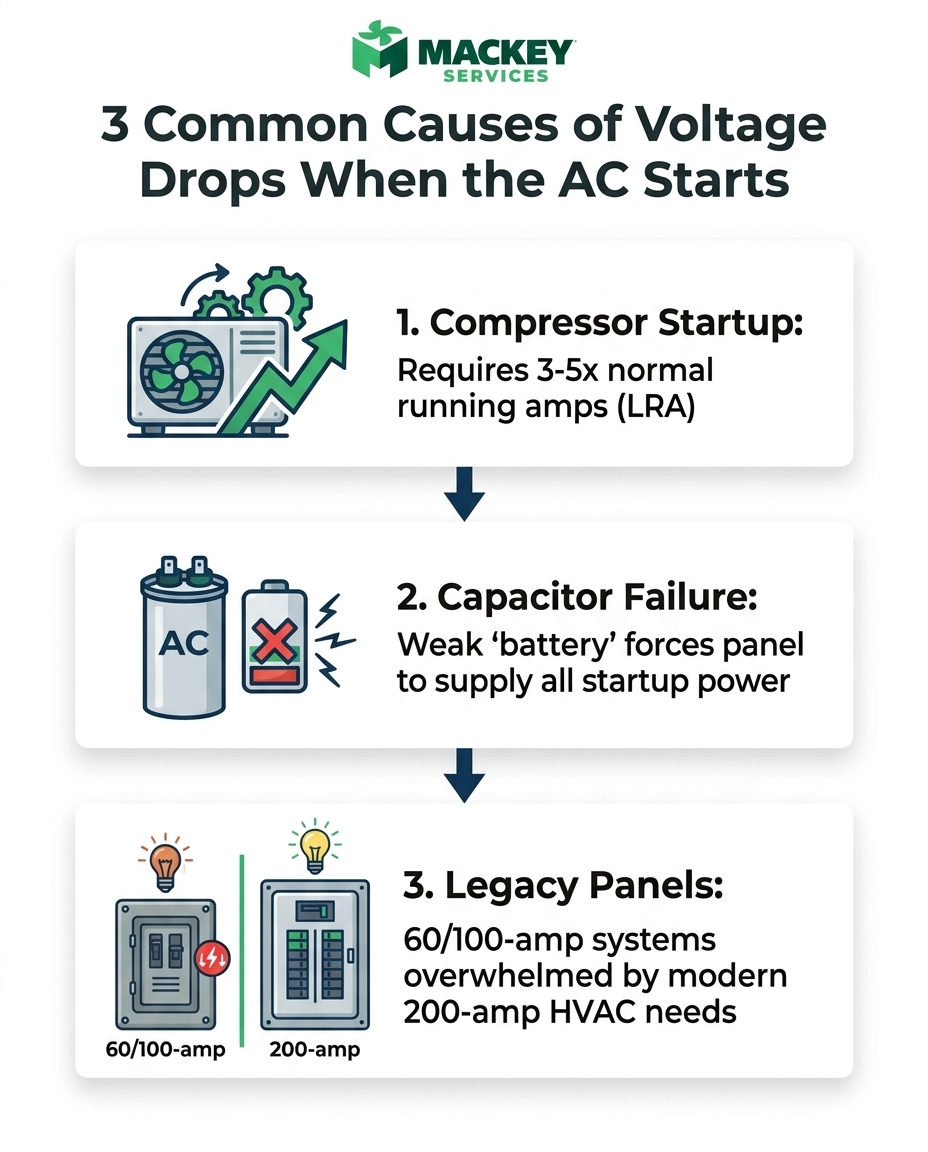
When our technicians are asked, "Why do lights flicker when the AC turns on?" the answer usually traces back to one of three primary causes we see almost daily out in the field:
- Failing AC capacitor: The system's "battery" is weak and cannot provide the necessary startup jolt, forcing the unit to pull excess power from the house.
- Undersized or degraded wiring: The home's electrical panel and circuits are not robust enough to handle the sudden surge without starving other circuits.
- Utility neutral issues: The incoming power supply from the street has a degraded connection, causing an imbalance across the home's electrical phases.
When the AC starts, this massive initial power draw briefly starves the rest of the electrical panel, causing the voltage across your lighting circuits to drop momentarily. This is why you see the physical symptom of dimming bulbs. If the system is struggling, professional AC diagnostic and repair is the safest way to evaluate the equipment.
Understanding Locked Rotor Amps (LRA)
The difference between running and starting: Every air conditioner has two different amperage ratings listed on its data plate: Running Load Amps (RLA) and Locked Rotor Amps (LRA). The RLA is the amount of electricity the compressor uses while it is actively running and cooling your home. The LRA is the amount of electricity required to break the inertia of the resting compressor and get the motor spinning.
Overcoming refrigerant pressure: The compressor needs a massive jolt of energy because it is not just spinning a fan; it is pushing against high-pressure refrigerant gas. This requires 3 to 5 times the normal running amperage. Think of it like pushing a heavy vehicle: getting it rolling from a dead stop takes intense effort, but keeping it rolling on a flat road takes much less energy. This massive LRA draw is what puts your electrical panel to the test every single time the thermostat clicks on.
Can a Bad Capacitor Cause Lights to Flicker?
Yes, a failing component within the air conditioner itself is the most common reason for pronounced voltage drops. Specifically, the AC compressor and dual run capacitor work together to manage the electrical load. The dual run capacitor acts like a large, short-term battery. Its job is to store electrical energy and release it in a fraction of a second, providing the necessary jolt of electricity to overcome the compressor's Locked Rotor Amps.
The problem: Over time, especially under the strain of continuous end-of-summer cooling, capacitors lose their ability to store a full charge. They drop out of their rated microfarad tolerance. When this happens, the capacitor can no longer provide the necessary boost.
The cause: Because the compressor still needs that massive amount of energy to start, it bypasses the weak capacitor and pulls all the required startup amperage directly from your home's electrical panel. This sudden, unmitigated drain pulls voltage away from your lighting circuits.
The solution: When a hard-starting compressor struggles to turn on, you will notice a prolonged dimming effect—the lights may dim for two, three, or even five seconds while the compressor groans and tries to start. In many cases, our technicians find that replacing the weakened capacitor restores normal operation. For older compressors that are mechanically tight, we might recommend installing a hard start kit. This device provides an even larger boost of stored energy to assist an aging compressor. However, a hard start kit should only be installed if properly diagnosed by a professional evaluating the entire HVAC system, as masking a failing compressor with a start kit can sometimes lead to more severe electrical damage.
How Do Older Electrical Panels Handle Modern HVAC Loads?
If the air conditioner's capacitor and compressor are functioning perfectly, the focus must shift to the home's electrical infrastructure. This is a particularly common issue in older Dickinson TX homes, many of which still rely on the original electrical panels installed decades ago.
Our electricians frequently encounter legacy panels rated for 60-amp or 100-amp total service. When these homes were built, families used far less electricity, and central air conditioning was a rare luxury. Today, a modern high-efficiency central AC system often requires a dedicated 30-amp to 50-amp circuit all by itself. When you pair a modern HVAC system with a legacy 100-amp panel, the AC startup load consumes half of the home's total available capacity in a single second.
| Panel Type | Total Capacity | Symptoms Under AC Load | Code Compliance |
|---|---|---|---|
| Legacy Panels | 60 to 100 Amps | Severe light dimming, warm breakers, occasional buzzing sounds. | Often outdated; may not meet current NEC requirements for modern loads. |
| Modern Panels | 200+ Amps | Minimal to no dimming; handles simultaneous heavy appliance use easily. | Meets modern safety codes and easily supports high-efficiency HVAC. |
Physical signs of panel distress: When legacy wiring is subjected to modern HVAC startup loads, the system experiences severe voltage drops. The wiring and the breakers can physically overheat due to the resistance. If you hear a buzzing noise coming from your breaker box when the AC starts, or if the breakers feel warm to the touch, the panel is struggling to safely pass the current. Upgrading a heavily loaded electrical panel or replacing legacy wiring is a strict code-compliance issue that requires licensed professionals. (Note: Generic federal tax credits or utility rebates may apply to qualifying electrical panel and energy-efficiency upgrades, so we advise readers to verify current programs with a tax professional). Never open a breaker panel to inspect the wiring yourself.
What Role Does the Utility Grid Play in Voltage Drops?
Sometimes, the root cause of flickering lights has nothing to do with your air conditioner or your electrical panel. The third major culprit lies outside the home entirely: the utility grid. Our team has traced countless mysterious voltage drops back to degraded utility connections. Residential homes are typically supplied with split-phase power, which consists of two 120-volt lines and one neutral line. The neutral wire acts as the return path for the electrical current, keeping the voltage balanced across the home.
The degraded neutral connection: Over time, weather, tree branches, or simple wear and tear can degrade the utility neutral connection at the weatherhead (where the power lines meet your roof) or at the transformer. When this connection becomes loose or corroded, the electrical current loses its clear return path. As a result, the voltage becomes unbalanced.
Spotting the symptoms: Symptoms of a bad neutral are very distinct. When a heavy 240-volt appliance like your air conditioner starts, it disrupts the fragile balance. You will often see lights in one room dim significantly, while lights in another room actually brighten or surge. This surging is a massive red flag that the neutral connection is failing, as appliances are suddenly receiving more than their rated 120 volts.
If our professionals diagnose a degraded utility neutral, we will advise you to contact your local utility company immediately to repair the incoming lines. For homeowners living in areas prone to frequent grid instability, severe late-summer weather, or brownouts, investing in backup generator services is a smart consideration to protect sensitive electronics and maintain comfort when the grid fails.
Is It Dangerous If Lights Flicker When the AC Starts?
The short answer is yes—we always caution our customers that it can be dangerous if the underlying cause is loose wiring, overloaded circuits, or a failing compressor. While a tiny, split-second dimming might just be the normal draw of Locked Rotor Amps, persistent or severe flickering is a symptom of a system under dangerous stress.
The risk to your electronics: Persistent voltage drops do not just affect your lightbulbs. Every time the voltage sags, the motors in your refrigerator, washing machine, and ceiling fans have to work harder, generating excess heat. Sensitive electronics like televisions and computers can suffer premature failure from constant voltage fluctuations.
The risk of fire and failure: If the flickering is caused by a loose connection in the breaker panel, that loose connection generates intense heat every time the AC starts. Over time, this heat degrades the wire insulation, leading to short circuits, melted components, and a serious risk of electrical fire. Ignoring the issue can also lead to tripped main breakers or permanent, catastrophic compressor damage.
Whether you are dealing with an end-of-summer cooling crisis or a winter heating system malfunction—like one customer experienced when our technician Tony had to safely repair their unit during a cold snap—ignoring electrical symptoms can lead to severe equipment damage or safety hazards. Safety must always come first, which means adhering to the absolute rule against DIY electrical troubleshooting for high-voltage HVAC circuits. If you are wondering why your main breaker trips when the AC kicks on, you need a licensed expert to safely test the load.
Do I Need an Electrician or an HVAC Tech for Flickering Lights?
This is the most frustrating dilemma for a homeowner facing voltage drops. Because the symptom (flickering lights) is electrical, but the trigger (the air conditioner) is HVAC, most companies force you to guess which trade to call. If you guess wrong, you risk paying multiple service fees.
Calling an electrician for what turns out to be a bad AC capacitor means the electrician might verify the panel is fine, but they cannot legally or practically repair the air conditioner. Conversely, calling a standard HVAC technician for a bad electrical panel means they might verify the AC is fine, but they cannot upgrade your home's wiring. This leads to incomplete diagnostics and unresolved hazards.
Working with Mackey Services eliminates this guesswork. Because our team maintains dual expertise in both HVAC and electrical systems, one of our professionals can seamlessly trace the voltage drop from the thermostat outside to the compressor, and all the way back to the main breaker box. You get a complete, accurate diagnosis from a single trusted source, ensuring the root cause is fixed safely and efficiently without the hassle of hiring two separate contractors.
Frequently Asked Questions About AC-Related Voltage Drops
Why do my lights dim when the AC turns on?
Lights dim when the AC turns on because the compressor requires a massive surge of electricity (Locked Rotor Amps) to start up. This sudden demand pulls power away from other circuits in the home, causing a momentary drop in voltage. While a split-second dimming is often normal, prolonged dimming indicates a failing AC capacitor, undersized wiring, or an overloaded electrical panel.
Is it dangerous if lights flicker when the AC starts?
Yes, it can be dangerous if the flickering is caused by loose electrical connections or an overloaded breaker panel. Loose connections generate intense heat under heavy loads, which can melt wire insulation and create a fire hazard. Furthermore, constant voltage drops can permanently damage sensitive electronics and appliances throughout your home.
Do I need an electrician or an HVAC tech for flickering lights?
You ideally need a professional trained in both disciplines, as the root cause could lie in the AC unit or the home's electrical panel. At Mackey Services, our dual-licensed technicians can test the AC capacitor and compressor, and if those are functioning properly, seamlessly transition to testing the breaker panel and wiring without requiring you to hire a second contractor.
Can a bad AC capacitor cause lights to flicker?
Yes, a failing dual run capacitor is one of the most common causes of AC-related flickering lights. The capacitor acts as a battery that provides the initial jolt of energy to start the compressor. When it weakens, the compressor is forced to pull all of its startup power directly from your home's electrical panel, causing a severe voltage drop.
Why does my AC compressor sound like it's struggling to start?
A struggling, groaning compressor is usually suffering from a lack of adequate startup voltage, often due to a failing capacitor or extreme mechanical wear. This condition, known as hard starting, keeps the compressor in its high-amperage startup phase for too long. This prolonged power draw is what causes severe light dimming and rapidly degrades the compressor motor.
How much does a hard start kit help with voltage drops?
A hard start kit helps significantly by providing a massive, stored boost of electrical energy directly to the compressor during startup. This reduces the amount of power the AC needs to pull from the home's electrical panel, which can eliminate light flickering. However, a hard start kit should only be installed if a professional determines the compressor is mechanically sound enough to benefit from it.
Stop Guessing and Secure Your Home's Electrical System Today
Flickering lights are a clear symptom of an electrical system under severe stress, not a minor quirk to be ignored. Whether the root cause is an aging dual run capacitor or an overloaded legacy breaker panel, addressing the voltage drop early protects your entire home. Enjoy the peace of mind that comes from having a single expert evaluate both your air conditioner and your electrical panel. Schedule a professional diagnostic with our team today before the intense late-summer heat causes a complete system failure right in the middle of back-to-school season.
Ready for a better day?
One call handles it all — HVAC, electrical, and generators across the Texas Gulf Coast. Less to pay. Better day. That's the Mackey way.
Mon–Fri: 7 AM – 8 PM · Sat: 8 AM – 5 PM · Licensed & insured · #TACLA 112769C · #TECL 558211