
The Ultimate Guide to HVAC System Lifespan
Discover how old is too old for an HVAC system in coastal Texas and learn when to repair or replace your aging unit for peak performance.
How Old Is Too Old for an HVAC System in the Greater Houston Area?
Knowing how old is too old for an HVAC system could save you from a breakdown in the middle of a Houston summer — or from spending money repairing a unit that's already on its way out. Most HVAC systems are built to last between 15 and 20 years, but here in the Greater Houston area, that timeline often runs shorter. Salt air, relentless humidity, and extreme heat put extra strain on cooling and heating equipment, meaning a 10- or 12-year-old system along the Gulf Coast may already be past its prime.
Here's a quick-reference guide to help you assess where your system stands:
| Equipment Type | Average Lifespan | Gulf Coast Lifespan | Consider Replacing At |
|---|---|---|---|
| Central Air Conditioner | 15-20 years | 12-15 years | 12-15 years |
| Gas Furnace | 15-30 years | 15-20 years | 15-20 years |
| Heat Pump | 10-15 years | 10-12 years | 10-12 years |
The bottom line: if your system is approaching or past those thresholds — especially if it's showing performance issues or needing frequent repairs — replacement is likely the smarter move.
That said, age alone doesn't tell the whole story. In this guide, we'll walk you through how to find your system's actual age, what warning signs to watch for, and how to use simple financial rules to make a confident repair-or-replace decision.
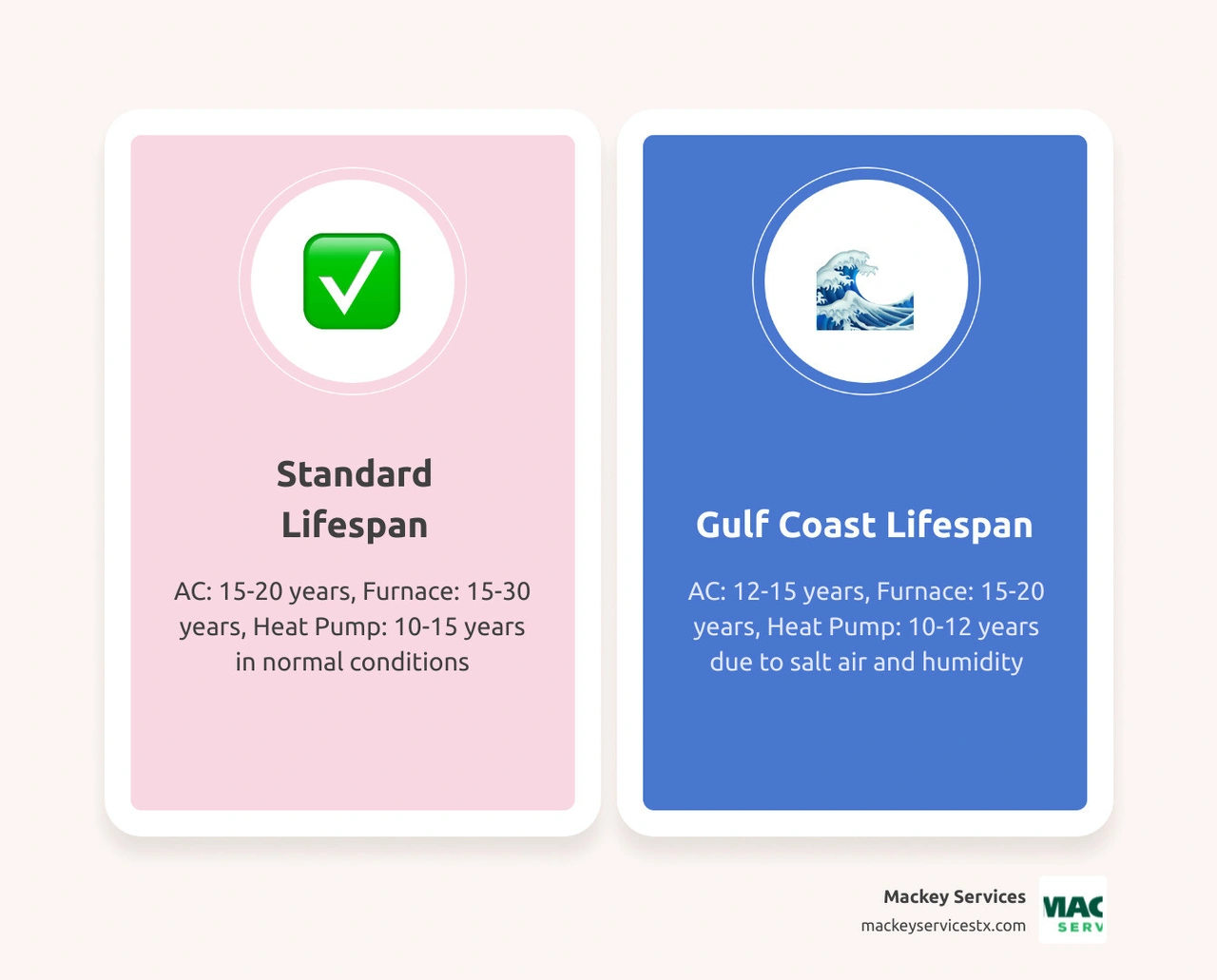
Typical Lifespan of Heating and Cooling Equipment
When evaluating whether your home comfort system is on its last legs, it is helpful to look at the typical lifespans of each specific component. While we often talk about "the HVAC" as a single unit, your air conditioner, furnace, and heat pump all have different mechanical demands and operational lifespans.
In a moderate climate, an air conditioner might easily cruise past its 15th birthday. However, things are different here in coastal Texas. To understand how long your equipment is expected to last, you have to look at the unique wear and tear each system faces in our region. For a deeper dive into local expectations, you can read our guide on How Long Does an AC System Last on the Gulf Coast.
Central Air Conditioners (12 to 15 Years in Coastal Texas)
In the Greater Houston area, our air conditioners are the undisputed workhorses of the home. Because they run for most of the year to combat temperatures that frequently soar past 90°F, they accumulate operational hours much faster than systems in northern states. By year 10, most central air conditioning systems run at only 80-85% of their original efficiency due to normal component degradation. In areas like Seabrook, Webster, and Galveston, the salt-heavy air accelerates coil corrosion, often shortening an AC unit's functional limit to 10 to 12 years if it is not meticulously maintained.
Gas Furnaces (15 to 20 Years)
Because our winters in places like Dickinson and Friendswood are relatively mild, gas furnaces do not have to work nearly as hard as our air conditioners. A well-maintained gas furnace can last anywhere from 15 to 25 years. However, the high indoor humidity during our long summers can cause moisture to settle on the metal components of an idle furnace, leading to rust and corrosion over time.
Heat Pumps (10 to 12 Years)
Heat pumps provide both heating and cooling, meaning they work year-round without a seasonal break. Because they are constantly running to keep your home comfortable in both July and January, their average lifespan is naturally shorter than a standalone furnace. In our coastal climate, a heat pump will typically require replacement consideration around the 10- to 12-year mark.
Determining How Old Is Too Old for an HVAC System
If you recently bought a home in League City, Pearland, or Alvin, or if you simply haven't kept track of the years, you might not know exactly how old your heating and cooling equipment is. Before you can decide if your system is reaching retirement age, you need to find its manufacturing date.
Knowing this date is a critical first step, especially because When Should You Replace Your AC in a Coastal Climate depends heavily on the physical age of the system combined with local environmental factors.
How to find the manufacture date to see if your system is too old
You do not need to dig through old house closing paperwork to find your HVAC's age. Instead, head outside to your condensing unit (the big metal box in your yard) and look for the manufacturer's nameplate. This is a metal or vinyl sticker containing technical specifications, model numbers, and serial numbers.
- Look for the "MFR DATE": Many modern manufacturers explicitly print the month and year of manufacture directly on the plate (e.g., "MFR DATE: 04/2016").
- Decode the Serial Number: If there is no clear date printed, write down the brand and the serial number. Most manufacturers hide the date within the serial number. For example, a serial number starting with "1604" might mean the unit was built in the 4th week of 2016, or in April of 2016.
- Search Online: You can quickly type the brand name and serial number into an online HVAC serial decoder to get an instant manufacturing date.
Why Gulf Coast humidity makes a 10-year-old system too old
A system that is 10 years old in a dry, mild climate might still have half its life ahead of it. But along the Texas Gulf Coast, a decade of service is a massive milestone.
Our high relative humidity and salty coastal breeze create a highly corrosive environment. Salt air reacts with the copper and aluminum coils in your outdoor unit, leading to a phenomenon known as " formicary corrosion." This creates microscopic holes in the coils, leading to persistent refrigerant leaks. To understand more about how our local weather shapes your equipment's health, read about How Gulf Coast Climate Affects Your HVAC System.
Telltale Signs Your Aging System Needs Replacement
Sometimes, a system tells you it is too old long before it completely stops turning on. If your system is celebrating its 12th or 15th birthday, you should keep a close eye out for warning signs. For a complete list of symptoms, check out our guide on 7 Signs It's Time for a New Air Conditioner Greater Houston.
Performance red flags and how old is too old for an HVAC system
- The "Thermostat Wars": If some rooms in your house feel like a sauna while others feel like an icebox, your aging system is struggling to distribute air evenly.
- Short Cycling: If your AC turns on, runs for three minutes, shuts off, and then repeats the process constantly, it is short cycling. This places immense strain on the compressor and causes your energy bills to skyrocket.
- Dust and Humidity Problems: An aging system loses its ability to dehumidify your indoor air. If your home feels sticky or you notice a persistent layer of dust settling quickly on your furniture, your system is no longer managing your indoor air quality effectively.
- The "Ghost in the Attic" Noises: Squealing, banging, rattling, or hissing sounds indicate that major mechanical components—like the blower motor or compressor—are reaching terminal wear.
Safety risks like carbon monoxide leaks in older furnaces
While an inefficient air conditioner will hurt your wallet, an aging furnace can pose actual safety hazards to your family.
As a gas furnace ages, the constant heating and cooling cycles cause the metal heat exchanger to expand and contract. Over 15 to 20 years, this stress can cause microscopic cracks to develop in the heat exchanger. A cracked heat exchanger can allow dangerous combustion gases, including carbon monoxide, to leak directly into your home's breathing air. Older systems also present elevated fire hazards due to degraded electrical wiring and worn contactors that can short-circuit.
Financial Frameworks: Repair vs. Replace Decisions
When your air conditioner breaks down on a sweltering July afternoon, your first thought is usually about the cost. Should you pay for a quick fix to get the cool air flowing again, or is it time to invest in a brand-new system?
To take the emotion out of this stressful situation, we recommend using objective financial formulas to guide your decision. You can explore this topic further in our dedicated article, Should I Repair or Replace My AC.
The 50% rule and how old is too old for an HVAC system
The 50% rule is a simple, time-tested benchmark. If the cost of a single repair exceeds 50% of the value of a brand-new system, replacement is almost always the wiser financial move.
For example, if your 12-year-old system needs a new compressor, and the repair bill is more than half the cost of a complete system upgrade, pouring that money into a terminal machine with no warranty coverage rarely makes financial sense.
The $5,000 rule for data-driven decisions
The $5,000 rule is a mathematical approach that factors in both the age of your system and the cost of the proposed repair.
Age of System (Years) × Cost of Repair = Decision Score
- If the score is under $5,000, repair the system.
- If the score is over $5,000, replace the system.
Let's look at two real-world examples:
- Scenario A: Your 6-year-old AC needs a new fan motor. The repair quote is $400. 6 × $400 = $2,400Since $2,400 is well below the $5,000 threshold, repairing the unit is a smart, cost-effective decision.
- Scenario B: Your 12-year-old AC needs a major repair costing $600.12 × $600 = $7,200Because $7,200 exceeds the $5,000 threshold, you are likely entering a "repair spiral" where you will end up replacing components one by one on a failing machine. In this case, upgrading is the better path forward.
The R-22 and R-410A refrigerant phase-out dilemma in 2026
If your air conditioner was manufactured before 2010, it almost certainly uses R-22 Freon. The EPA completely phased out the production and import of R-22, meaning the remaining supply is extremely scarce and incredibly expensive. If an R-22 system develops a refrigerant leak, recharging it can cost nearly as much as a down payment on a new system.
Even if your system uses the newer R-410A refrigerant, you should be aware of current environmental transitions. As of 2026, the EPA's phasedown of R-410A is driving up the cost of this chemical as the industry transitions to next-generation refrigerants. If your 12-to-15-year-old system has a major refrigerant leak, repairing it is often a temporary band-aid on a system that is fundamentally outdated.
Maximizing Longevity Through Professional Maintenance
While we can't change the calendar, we can change how gracefully your HVAC system ages. The single most effective way to prevent your system from becoming "too old" prematurely is through regular preventive care.
To learn more about maximizing your system's life, read A Homeowner's Guide to Extending Your HVAC System's Lifespan and discover How Regular Maintenance Gives Your HVAC System a Longer Lifespan.
Benefits of routine AC maintenance for coastal Texas homes
Our hot, humid climate means your system's outdoor coils act like a magnet for salt, dirt, grass clippings, and airborne grime. When a thick layer of buildup coats these coils, your system cannot release heat efficiently, forcing the compressor to run hotter and work twice as hard.
Routine maintenance ensures that:
- Outdoor and indoor coils are thoroughly cleaned to maintain proper heat transfer.
- Condensate drain lines are cleared to prevent water damage and mold growth in your home.
- Electrical connections are tightened to prevent voltage spikes and component failure.
For practical steps you can take, explore our Benefits of Routine AC Maintenance and review our HVAC Maintenance Tips for Coastal Texas Homeowners.
Why an HVAC maintenance plan is worth it
An annual maintenance plan takes the guesswork out of caring for your heating and cooling systems. Instead of waiting for a breakdown in the middle of an August heatwave, a professional maintenance plan provides scheduled, bi-annual tune-ups (spring for cooling, fall for heating) to catch minor issues before they turn into major emergencies. To see if this is right for your home, read Is an HVAC Maintenance Plan Worth It.
Frequently Asked Questions about HVAC Lifespan
Can an HVAC system last 30 years?
While it is technically possible for high-quality, cast-iron boilers or exceptionally well-maintained gas furnaces in mild climates to reach the 30-year mark, it is incredibly rare for a central air conditioner or heat pump to do so—especially in Texas. Even if a system survives that long, its operating efficiency will be incredibly low compared to modern standards, costing you significantly more in monthly utility bills than the cost of an upgrade.
Does a 10-year-old AC need replacing?
Not automatically. If your 10-year-old system has been professionally maintained twice a year, has a clean repair history, and is still cooling your home comfortably, there is no need to rush into a replacement. However, you should begin planning and budgeting for an upgrade within the next few years, as components naturally begin to degrade and lose efficiency around this milestone.
What role do federal tax credits and rebates play in replacement?
Under the Inflation Reduction Act, homeowners can access substantial federal tax credits to offset the cost of energy-efficient upgrades. For qualifying high-efficiency heat pumps, you may eligible for a tax credit of 30% of the project cost, up to $2,000. For qualifying high-efficiency central air conditioners and gas furnaces, tax credits of up to $600 are available. These incentives make upgrading an old, inefficient system much more financially attractive.
Conclusion
Determining how old is too old for an HVAC system comes down to balancing calendar years against performance, safety, and repair costs. If your system is over 12 years old and starting to show signs of struggle, continuing to patch it up can quickly turn into a financial trap.
At Mackey Services, we have been helping our neighbors in Dickinson, Friendswood, League City, and the Greater Houston Area stay comfortable since 1992. As a family-owned business with an A+ rating from the Better Business Bureau, we believe in providing honest, family-like service with zero high-pressure sales tactics. Whether you need a simple tune-up, a reliable repair, or a complete system replacement with custom-fabricated ductwork, our certified team is ready to help 24/7.
Are you ready to find out exactly where your home comfort system stands? Schedule your professional HVAC evaluation with Mackey Services today, and let us help you keep your home safe, efficient, and perfectly cool for years to come.
Ready for a better day?
One call handles it all — HVAC, electrical, and generators across the Texas Gulf Coast. Less to pay. Better day. That's the Mackey way.
Mon–Fri: 7 AM – 8 PM · Sat: 8 AM – 5 PM · Licensed & insured · #TACLA 112769C · #TECL 558211