
Everything You Need to Know About When to Upgrade from Portable to Whole Home Generator
Learn when to upgrade from portable to whole home generator for reliable Gulf Coast backup power and automatic home protection.
When to Upgrade from Portable to Whole Home Generator: What Houston Homeowners Need to Know
Knowing when to upgrade from portable to whole home generator is one of the most important decisions you can make as a homeowner on the Gulf Coast — especially when hurricane season can knock out power for days at a time. If you've been relying on a portable unit and wondering whether it's time to make the switch, you're not alone. Here in the greater Houston area, storms, grid instability, and extreme heat make reliable backup power more than a convenience — it's a safety issue.
You should upgrade from a portable to a whole home generator when:
- Power outages in your area last more than 24 hours or happen multiple times per year
- You have medical equipment, a sump pump, or HVAC that must stay on without interruption
- Manual refueling and setup has become a burden or safety risk
- Your household has grown and essential power needs now exceed your portable unit's capacity
- You want automatic power restoration without any action on your part
- You own your home and plan to stay long-term, making a permanent system a smart investment
- Fuel access becomes unreliable during major storm events when gas stations lose power too
For many Houston-area homeowners, the tipping point isn't a single reason — it's a combination of outage frequency, safety concerns, and the simple exhaustion of managing a portable generator in the middle of a storm.
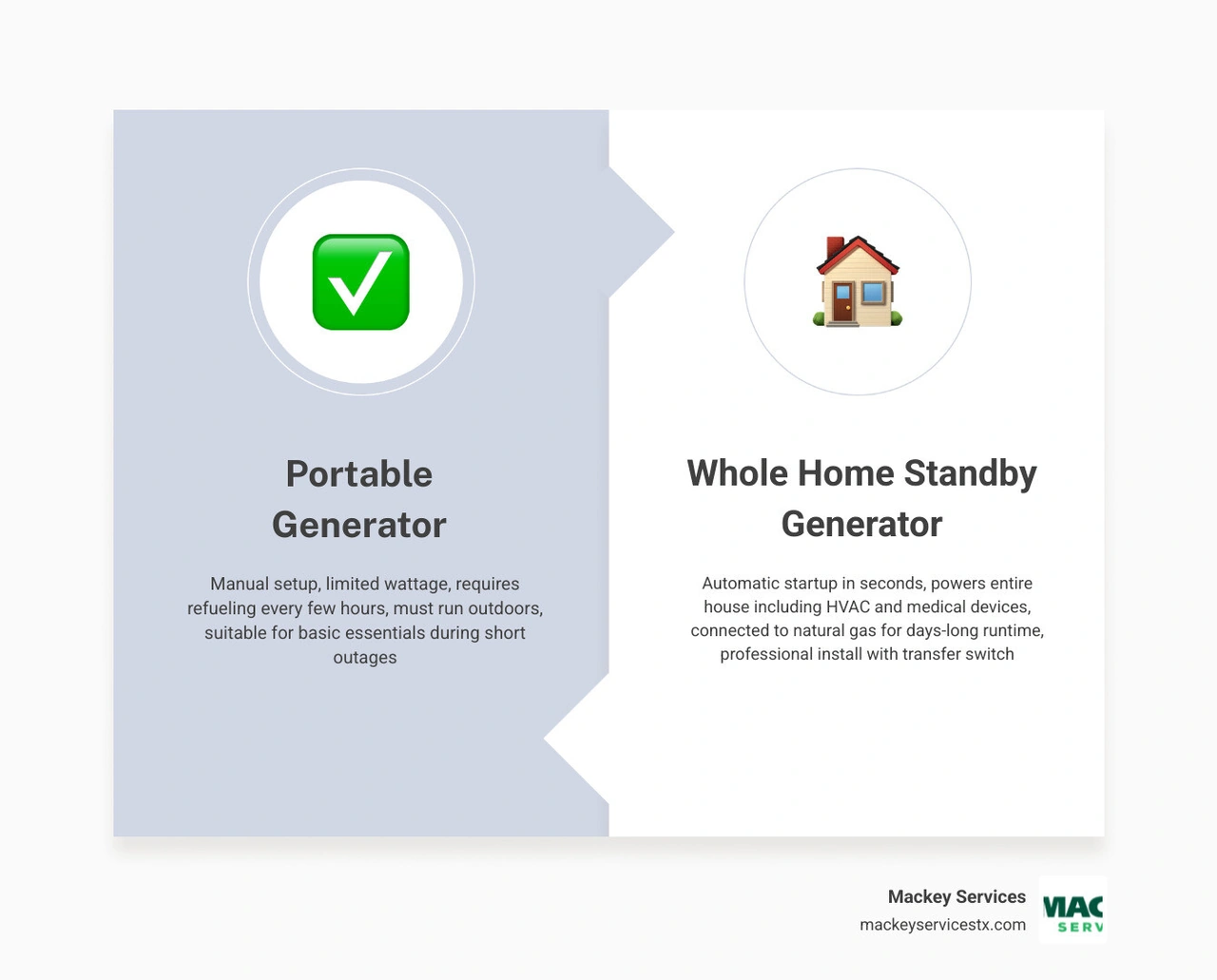
Portable vs. Standby: Understanding the Core Differences
Before diving into the exact timing of your upgrade, it is essential to understand how these two systems differ fundamentally in design, fuel delivery, and daily operation.
Portable generators are mobile units designed for temporary, localized power. They are fantastic for camping, tailgating, or running a few extension cords to your refrigerator and a couple of lamps during a brief blackout. However, they require manual intervention at every step. You must wheel the unit out of storage, position it safely away from your home, fill it with fresh gasoline, pull-start or electric-start the engine, and manage a web of heavy-duty extension cords.
Standby generators, on the other hand, are permanent fixtures installed on a concrete pad outside your home, looking very similar to a central air conditioning unit. They are hardwired directly into your home's electrical panel via an automatic transfer switch (ATS) and connected permanently to your local utility lines (natural gas or liquid propane).
To help you visualize these differences, we have put together a comprehensive Whole House Generator vs Portable Generator Comparison that outlines the core characteristics of each path:
| Feature | Portable Generator | Whole-Home Standby Generator |
|---|---|---|
| Installation | None (unless adding a manual transfer switch) | Professional installation, concrete pad, utility connections |
| Power Capacity | Typically 2,500 to 8,500 watts | Typically 8,000 to 22,000+ watts |
| Startup | Manual (pull-start or key switch in the storm) | Automatic (restores power in under 15 seconds) |
| Fuel Source | Gasoline, diesel, or portable propane tanks | Natural gas line or large liquid propane tank |
| Runtime | Limited by fuel tank capacity (requires manual refuels) | Indefinite on natural gas; days/weeks on propane |
| Appliance Coverage | Selective essentials (fridge, fan, basic lights) | Whole-house coverage, including central HVAC |
| Safety Profile | High risk of carbon monoxide if placed improperly | Extremely safe, permanent outdoor placement |
| Property Value | None (you take it with you when you move) | Increases home resale value as a permanent asset |
Power Capacity and Appliance Demands
One of the primary catalysts for upgrading is realizing that your portable generator simply cannot keep up with your household's electrical load. Standard portable generators typically cap out around 8,500 running watts, which is sufficient for a refrigerator, a few phone chargers, and perhaps a portable window AC unit.
However, modern households have much higher demands. Central air conditioning units, electric water heaters, pool pumps, and electric ovens require substantial starting surge watts to get up and running. A central HVAC system alone can easily overwhelm a standard portable unit.
When you upgrade to a standby system, you gain access to power outputs ranging from 8,000 to over 22,000 watts. This allows you to run your entire home seamlessly. But how is this managed so efficiently? To understand the mechanics of how these systems safely energize your electrical panel, you can read our detailed guide on How Does a Whole Home Backup Generator Work.
Manual Setup vs. Automatic Restoration
Convenience is often the ultimate deciding factor. Imagine this scenario: it is 2:00 a.m. in the middle of July, a severe Gulf Coast thunderstorm has knocked out the power, and the indoor temperature is climbing rapidly.
If you have a portable generator, you must put on your rain gear, grab a flashlight, drag a heavy machine out of your garage, and attempt to start it in pouring rain. You must also worry about whether your stored gasoline has stabilized or if it has degraded over the last several months.
With a standby generator, the automatic transfer switch constantly monitors utility power. Within 10 to 15 seconds of a power failure, the standby unit detects the loss, starts automatically, disconnects your home from the utility grid to prevent dangerous backfeeding, and begins supplying clean power to your entire house. You do not have to lift a finger. Whether you are fast asleep, at work, or out of town on vacation, your home remains fully powered, air-conditioned, and secure.
Key Indicators of When to Upgrade from Portable to Whole Home Generator
Many homeowners start their emergency backup journey with a portable unit, which serves as an excellent temporary fix. However, as life changes, your backup power strategy should evolve too. If you are currently living in Friendswood, TX, and finding that your portable unit is more of a headache than a help, it may be time to consider a permanent solution. You can explore our local services at Whole House Generator Friendswood TX to see how we help your neighbors make this exact transition.
Outage Frequency and Severe Gulf Coast Weather
Living in the Greater Houston area, from Dickinson to Pearland, means dealing with some of the most unpredictable weather in the country. From intense summer hurricanes and tropical storms to winter freezes that put extreme stress on our electrical grid, extended blackouts are no longer a rare occurrence.
If your neighborhood experiences multiple power outages a year, or if you find yourself without power for several days at a time, relying on a portable generator becomes a logistical nightmare. Sourcing 15 to 20 gallons of gasoline per day during a widespread blackout is incredibly difficult. Local gas stations often lose power themselves, leading to massive lines and fuel shortages.
Upgrading to a standby unit connected directly to a natural gas line eliminates the need to hunt for fuel during a crisis. If you reside in Deer Park, TX, and want to ensure your home is fully prepared before the next major storm season, check out Whole House Generator Installation Deer Park TX to learn about our local installation process.
Critical Household Needs and Medical Equipment
For many families, keeping the lights on is not just about comfort—it is a matter of health and safety. The decision of when to upgrade from portable to whole home generator becomes urgent when you have:
- Critical Medical Devices: CPAP machines, oxygen concentrators, home dialysis equipment, and refrigerated medications require uninterrupted power. A 15-minute delay to set up a portable generator in a storm is simply not an option.
- Remote Work and Home Offices: With more professionals working from home in 2026, a sudden power outage can disrupt critical business operations, cause data loss, and disconnect you from clients.
- Sump Pumps and Flooding Risks: Low-lying areas on the Gulf Coast are highly susceptible to flooding. If your home relies on a sump pump to keep your crawlspace or basement dry, a power outage during a heavy downpour can lead to catastrophic water damage if your pump goes offline.
- Food Preservation: Losing hundreds of dollars in groceries or high-value frozen items due to a spoiled refrigerator is incredibly frustrating and expensive.
Safety, Maintenance, and Operational Considerations
While standby generators offer unmatched convenience, they are sophisticated pieces of machinery. Understanding the safety advantages and maintenance requirements of these systems is crucial to ensuring they are always ready to protect your home.
Carbon Monoxide Risks and Safe Placement
The most critical safety hazard associated with portable generators is carbon monoxide (CO) poisoning. According to safety organizations, improper portable generator placement is a leading cause of non-fire carbon monoxide deaths during major weather emergencies.
Because portable units are loud and vulnerable to theft, homeowners occasionally make the dangerous mistake of running them in garages, carports, or too close to open windows and doors. Portable generators must always be placed at least 20 feet away from the home with the exhaust pointed away from all structures.
Standby generators completely eliminate this operational risk. They are permanently installed at a safe, code-compliant distance from your home's windows and doors. Additionally, because they are housed in weather-proof, sound-attenuated enclosures, they operate much more quietly—typically between 60 to 70 decibels—compared to the roaring 80+ decibels of an open-frame portable generator.
However, like any engine, standby units require professional care to maintain their safety and reliability. To learn more about keeping your system in peak condition, read our guide on Do Backup Generators Require Maintenance.
Why Standby Systems Require Professional Installation
A whole-home standby generator is not a plug-and-play appliance. It requires a seamless integration of high-voltage electrical wiring, plumbing for fuel lines, and strict adherence to local building codes and permitting laws.
During installation, we must:
- Size and Install the Automatic Transfer Switch (ATS): This switch acts as the brain of the system, isolating your home from the utility grid to prevent dangerous backfeeding, which can injure utility workers trying to restore power.
- Upgrade Your Gas Meter or Line: A standby generator requires a high volume of natural gas or propane to run at full capacity. Standard residential gas lines often need professional sizing and pressure testing to handle the load.
- Secure Local Permits: Cities throughout the Houston area have strict setback requirements, noise ordinances, and electrical codes.
If you live in Pearland and are ready to transition to a safe, professionally installed system, our team is ready to help. Discover our local expertise at Whole House Generator Pearland TX.
Is a Standby Generator the Right Investment for Your Home?
Upgrading to a standby generator is a significant home improvement project. While the initial investment is higher than purchasing a basic portable unit, the long-term benefits, safety, and peace of mind make it a highly rewarding decision for many families. To explore the financial and practical returns of this upgrade, take a look at our article, Is a Whole House Generator a Wise Investment.
Long-Term Property Value and Insurance Benefits
Unlike a portable generator, which leaves with you if you sell your home, a standby generator is a permanent home improvement that stays with the property. In storm-prone regions like the Texas Gulf Coast, home buyers place an incredibly high premium on properties that feature built-in storm readiness. Remodeling cost-vs-value studies consistently show that a professionally installed standby generator can increase your home's resale value by a significant portion of its installation cost.
Furthermore, many insurance providers offer discounts on the property portion of homeowners' insurance policies for homes equipped with permanent standby generators. Because these systems keep your heating and cooling systems active, they prevent secondary storm damage like frozen pipes, high-humidity mold growth, and flooding from inactive sump pumps—reducing the likelihood of costly insurance claims.
Deciding When to Upgrade from Portable to Whole Home Generator
If you are trying to pinpoint the exact timing of your upgrade, consider your fuel logistics. Are you tired of keeping several cans of gasoline in your garage, worrying about fuel stabilizers, and rushing to the gas station before a storm? If you have access to a natural gas line on your property, upgrading to a standby unit allows you to tap into an uninterrupted fuel supply that runs indefinitely. Even if you rely on liquid propane, a large, permanently installed tank can power your home for days or weeks without requiring a single manual refuel.
How to Plan Your Transition and When to Upgrade from Portable to Whole Home Generator
Transitioning to a standby system is a straightforward process when you work with experienced professionals. Here is how we help you plan your upgrade:
- Load Analysis: We perform a comprehensive calculation of your home's peak electrical demand to determine the exact kilowatt (kW) capacity you need.
- Placement Strategy: We identify the ideal location on your property that complies with local municipal codes, utility access points, and safety setbacks.
- Permits and Coordination: Our team handles all necessary electrical, plumbing, and building permits, ensuring a hassle-free installation from start to finish.
Frequently Asked Questions About Generator Upgrades
Can a portable generator safely power a whole house?
While a high-capacity portable generator can power a significant portion of your home, it cannot safely power an entire modern house without careful load management. To connect a portable unit to your home's electrical panel, you must install a manual transfer switch or an interlock kit.
Never attempt to "backfeed" your home by plugging a generator directly into a wall outlet, as this is highly illegal, dangerous, and can send high-voltage electricity back into the utility lines, putting line workers' lives at risk. Even with a safe transfer switch, you will have to manually choose which circuits to run to avoid overloading the portable unit.
How long can a whole home standby generator run continuously?
A standby generator connected to a natural gas line can theoretically run indefinitely, as long as the utility supply remains active. If running on liquid propane, your runtime is limited only by the size of your tank.
However, during extremely long outages (such as those lasting several consecutive days), we recommend temporarily shutting down the unit every 24 to 48 hours to check the oil level, change the oil filter if necessary, and clear any debris from the enclosure. For a complete checklist of post-storm care, read our guide on Generator Maintenance After a Power Outage.
Do standby generators require regular maintenance?
Yes. Just like your car, a standby generator relies on an internal combustion engine that needs regular maintenance to ensure it starts reliably when the grid goes down. Standby units are designed to run automatic "exercise cycles" once a week or once a month for about 10 to 12 minutes. This self-diagnostic run keeps the engine lubricated, charges the battery, and alerts you to any potential issues before an actual power outage occurs. Professional annual service, including oil changes, spark plug replacements, and battery checks, is highly recommended.
Conclusion
Deciding when to upgrade from portable to whole home generator comes down to shifting your focus from temporary survival to complete, uninterrupted home comfort. While portable units serve as a great starting point, they cannot match the safety, convenience, and absolute peace of mind that a permanent standby system provides.
At Mackey Services, we have spent over 30 years helping families in Dickinson, TX, and throughout the Greater Houston area stay comfortable and secure in every season. As a family-owned business with an A+ BBB rating, we pride ourselves on delivering reliable, personalized service. Whether you need a comprehensive load assessment for a new generator, professional electrical work, or our signature $49 AC tune-up to keep your cooling system running efficiently in the Texas heat, we are here to help.
Don't wait for the next storm to catch you unprepared. Schedule a generator consultation today and let our licensed team design the perfect backup power solution for your home.
Ready for a better day?
One call handles it all — HVAC, electrical, and generators across the Texas Gulf Coast. Less to pay. Better day. That's the Mackey way.
Mon–Fri: 7 AM – 8 PM · Sat: 8 AM – 5 PM · Licensed & insured · #TACLA 112769C · #TECL 558211